It was a pleasure to return to the Pari Centre for New Learning (even if virtually) to present this introduction to the thinking of ecological anthropologist Gregory Bateson.. There will be a Pt 2 continuation of this, early in 2023.
rheomode
a research practice led by dr jon goodbun, working at the intersection of architecture, technology, art and ecological pedagogy. based in athens and london
most of my published papers can be found at https://rca.academia.edu/JonGoodbun
x/insta: @jongoodbun email: jon.goodbun@rca.ac.uk
-
Take Back the Land – Green New Deal Landscapes

Happy to have co-authored with my colleagues Godofredo Pereira and Christina Geros a chapter ‘Take Back the Land’ based on our work on the MA Environmental Architecture programme at the RCA London, in the new AD issue ‘Green New Deal Landscapes’ edited by Jose Alfredo Ramirez.
I will be discussing this at the book launch hosted by the Architectural Association (AA) London on Wednesday 23 February 2022
https://www.aaschool.ac.uk/publicprogramme/whatson/green-new-deal-landscapes
-
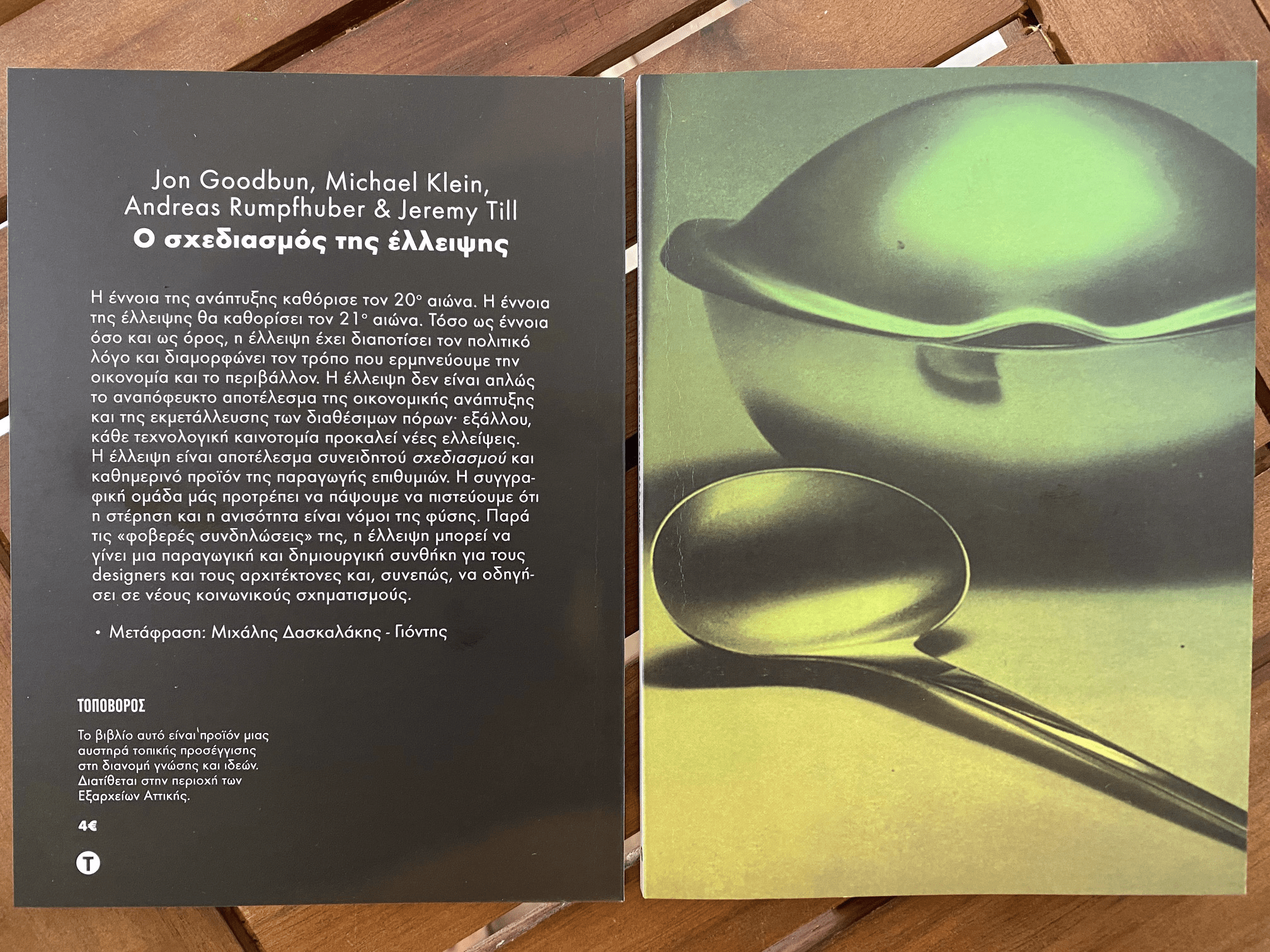
The Design of Scarcity translated into Greek
It was wonderful to find out that a local independent Athenian activist publisher – https://topovoros.gr/ – has translated The Design of Scarcity into Greek recently… this joins the 2018 German translation of the 2014 original published by Strelka.

-
Green New Dialogues – Towards a World in which Many Worlds Fit
On September 16th and 17th 2020 I organised two days of workshops and lectures for the RCA cross-college Doctoral Training Programme, which included a first day on ‘Ecologies of Care’, which featured Susana Calo talking about her research (with Godofredo Pereira on CERFI) and Nora Bateson on Warm Data. The second day focused on the Green New Deal, and included Adrian Lahoud on Rights of Future Generations, Julian Siravo from Commonwealth on their GND report, and I gave an abridged version of a paper on the Green New Deal to be published in Making Futures, called Green New Dialogues. This is me giving that paper:
-
RCA Environmental Architecture: Earthseeds
To celebrate the completion of the 2019-20 cohort we hosted a series of events as ‘Earthseeds’. I enjoyed chairing the discussion with Jessika Khazrik.
Spanning three days, Earthseeds is led by the student community from both graduating cohorts, and features talks, conversations, performances and group discussions, focusing on issues of care, the environment, technology, climate and social justice.
The title, Earthseed, is in reference to Octavia Butler’s book Parable of the Sower. To sow, to care, to adapt, to persist in the face of adversity and to change: a story that speaks to the uniqueness of this year and to our students’ capacity for adaptation and creativity even in the most difficult circumstances.
This is our first graduation show to take place online – the RCA2020 platform provides a profile of the work of each graduate, and their work is showcased using a range of dynamic formats.
Delve into their work and explore the platform by searching graduate names or browsing by Programme or exploring topical themes told through stories.
Earthseeds presents six separate events over three days:
- Earthseed #01 – This event is a celebration of the work produced by the MA City Design and MA Environmental Architecture students at the School of Architecture, Royal College of Art.
- Earthseed #02 – A Conversation with Kali Akuno of Cooperation Jackson
- Earthseed #03 – ‘The Cleaner Your Whole House Will Be’ with Jessika Khazrik
- Earthseed #04 – Curators Anna-Sophie Springer and Maria McLintock in conversation with students from the MA Environmental Architecture.
- Earthseed #05 – Architects Stavros Stavrides and Tiago Mota Saraiva in conversation with students from the MA City Design
- Earthseed #06 – Collecting Voids: An educational literary dialogue between Environmental Architecture and City Design

-
Bartlett/UCL MA Architecture Seminar 2020-21: Green New Deal/Green New Dialogues: Towards a World in which Many Worlds Fit
Among my various teaching positions is a decade long post at the London’s Bartlett School of Architecture (UCL), where I have the pleasure to run an elective seminar each year for a selection of MA Architecture Students, broadly titled The Ecological Calculus. I attach this years reading programme below
HT6 Green New Dialogues – Towards a world in which many worlds fit.
Dr Jon Goodbun 2020-21
The call for environmental justice, and the recognition that the effects of environmental change will be played out through class, gender, race and neo-colonial structures, articulates an essential socialisation and politicisation of what is at stake in thinking through our responses to ecological crisis.
Given the emerging scale of the environmental transformations that we are still now only in the early stages of, demands for a new planetary project of ecological planning are being raised from many quarters. These demands call for rapid and fundamental changes to the global supply chains and processes of production that feed our transportation, energy, food, manufacturing and production systems. Questions of planning confront us at every scale, from the implementation of the recommendations of the UN IPCC, through the measurement geopolitical resource flows through new international solidarities, to emissions management and carbon sequestration, land use changes and so much more. As these demands hit the ground within specific historically and geographically determined conditions, they become inseparable from questions of environmental justice, questions of ownership, and questions of social management. The need for both critical reflection and multi-dimension design research in architecture, urbanism, landscape studies and design activism is clear.
This double demand, for climate justice AND for an urgent ecological reorganisation and decarbonisation of the global production, have been articulated in different ways through practically all of the various Green New Deal proposals to have emerged in recent years.
The first Green New Deal was proposed in 2008, in a joint paper written in the UK by a group from the UK Green Party and the New Economics Foundation, called the Green New Deal Group. This group has expanded and continued to produce new work to this day, including the introduction of a Green New Deal Bill (unsuccessfully) to the UK Parliament in 2019, by Green MP Caroline Lucas and Labour MP Clive Lewis, and which fed into the manifestos of both the UK’s Green and Labour Parties manifestos in the 2019 General Election. In the same year in the USA, the Green New Deal Resolution was put to the US House of Representatives by Representative Alexandria Ocasio-Cortez (AOC) and to the Senate by Senator Ed Markey, a platform that was also later adopted by the Bernie Sanders presidential campaign, and which is now strongly influencing (albeit with resistance to its more radical aspects) the emerging manifesto of likely Democratic candidate Joe Biden.
Almost all of the Green New Deal papers have three main components in some form or other, perhaps most clearly laid out in the 2019 Green New Deal for Europe report put forward by Yannis Varoufakis and the DiEM group: 1. Green Public Works: a broad green transition, decarbonisation and job creation programme organised around an environmental justice agenda, 2. a new democratic, legal and institutional infrastructure for delivering this and achieving a just transition, and 3. an Environmental Justice Commission with a global remit.
There were problems with the GND proposals as they stood in 2019. The adoption of a political imaginary from 30s depression-era US history might resonate in that region, and maybe UK/Europe, but it could easily be a problem in the rest of the world. Similarly, it was not clear how the demands for the growth of a new green infrastructure in the world’s richest nations would not actually reinforce an extractivist flow of mineral resources from the global south – such as lithium, cobalt, copper etc – and intensify some of the most environmentally problematic practices on the planet, almost invariably involving the exploitation and desecration of indigenous lands and peoples. In short, the GNDs, for all of their intentions otherwise, invariably articulated themselves through national concerns, and frequently risked unleashing a new green colonialism.
The defeats sustained by the green left (Corbyn and Sanders) across Europe and North America and beyond through 2019 and into 2020 might well have been expected to have sunk the renewed interest in a Green New Deal agenda before it could really get going. But that has not been the case. There are several reasons for that.
The SARS-CoV-2 virus, was identified in December 2019 in Wuhan, China. The first victims of the disease that it causes – COVID-19 –, have now been traced back a month earlier. By April 2020 the World Health Organisation had declared it a pandemic and it had spread around the world, placing large sections of the global economy in an uneven shutdown. In fact, the uneven pattern of infections, deaths, and changed spatial and labour relations, revealed that a pandemic is never simply the product of a mass of viruses, spreading through a neutral space and affecting everyone equally. It is rather, the result of what happens when our normally obscured environmental architectures of social relations act as a discriminating exposure infrastructure for pathogens and pathologies of all kinds.
The evidence is clear that the death rates for working class ethnic minorities from COVID-19 are quite disproportionate. Being poor and black is, it turns out, in terms of medical statistics, a pre-existing condition. But the death and serious infection rates for ethnic minorities under COVID-19 are simply amplifying what we have already long known – that environmental change, breakdown and crisis, ALWAYS play out through the class, gender, race and neo-colonial structures.
Arguably today the single most important development as the GND has moved beyond a green infrastructure and solutions-based discussion, towards the broader dialogue now maturing into a multi-scalar counter-hegemonic political project, has been the productive and critical engagement of indigenous communities across the Americas and beyond with the GND question. This is certainly in no small part due to the fact that Ocasio-Cortez was already recognised by these communities as a ‘Water Protector’, through her activist work at Standing Rock in opposition to the oil pipeline across Sioux lands, which preceded her standing for election to Congress.
The Indigenous Environmental Network called for any GND to work within their Just Transition framework, cautioned against using the language of ‘stakeholders’ rather than ‘rights holders’, and strongly criticised the adoption of REDD+ (simplistic reforestation to offset emission) and the use of a language of zero-emissions, which they argue is always ultimately the language of a carbon trading ‘green’ capitalism.
Meanwhile revolutionary indigenous activists The Red Nation – published their response, the Red Deal, stating that:
‘it’s not the Red New Deal as it is the same ‘Old Deal’ – the fulfilment of treaty rights, land restoration, … ours is the oldest class struggle in the Americas: centuries long resistance for a world in which many worlds fit… The Red Deal is not a counter program to the GND. It is a call for action beyond the scope of the US colonial state.’
The environmental racism revealed by the COVID-19 pandemic has helped to feed a massive new wave of struggle around #blacklivesmatter and #antifa, in parallel with an unfolding political and economic struggle over the repercussions – both positive and negative – of the lockdown of economic activity. For those now fighting for a just recovery, and those who want to use this moment to restructure and rebalance the global economy, have found in the GND a set of ready made positions to align with.
However, there are fundamental problems regarding the very possibility of planning and justice. We need to somehow plan these changes, but we need also need to totally reimagine the very possibilities of planning, as a part of the problem is our ideas about planning themselves, or rather, the very fact of our attempting to plan anything, especially regarding ecological systems. When goals are set by an instrumental conscious purpose based upon a necessarily partial viewpoint, and unmediated by a wider eco-systemic awareness, all kinds of pathologies play out. The great lesson of radical cybernetics was not ‘how to control ecological systems’ but rather that we can’t control ecological systems. We can steer a boat, but we can’t steer an ocean…
This seminar will review the key documents that have emerged regarding the Green New Deal in recent years, and the wider global discussion, in particular looking at responses from indigenous communities and the Global South. In particular, we will take up the Zapatista demand – rearticulated by The Red Nation – for a ‘world in which many worlds fit’ as the key framework for articulating a Green New Dialogue…
Week 1: Designing in the End Times
UN IPCC Summary Report:
Summary for Policymakers of IPCC Special Report on Global Warming of 1.5°C approved by governments
Jon Goodbun interview with Caliper Journal:
https://caliperjournal.online/TOM-LEMON-DR-JON-GOODBUN
Kathryn Yusoff, A Billion Black Anthropocenes or None. University of Minnesota Press. Minneapolis, 2018
(Available free online at https://manifold.umn.edu/read/untitled-5f0c83c1-5748-4091-8d8e-72bebca5b94b/section/5cd42c2a-f2fe-4d41-89ae-cb891dc634b5)
Secondary
Zadie Smith, What Do We Want History to Do to Us?
Week 2: The Green New Deal: Problems and Possibilities
Alexandria Ocasio-Cortez, Naomi Klein and The Intercept:
A Message From the Future With Alexandria Ocasio-Cortez
DiEM, A GND for Europe/A Blueprint for Europe’s Just Transition:
Why Race Matters When We Talk About the Environment, An interview with Dr. Robert Bullard
Secondary
Labour for a GND:
https://www.labourgnd.uk/our-vision
Green Party: What is the GND
https://20for2020.greenparty.org.uk/articles/gnd
Jon Goodbun, ‘Green New Dialogue’, in Making Futures. Berlin, 2021 (prepub)
Kate Aronoff, Alyssa Battistoni, Daniel Aldana Cohen and Thea Riofrancos, A Planet to Win – Why We Need a Green New Deal
Noam Chomsky and Robert Pollin, Climate Crisis and the Global Green New Deal
Ann Pettifor, The Case for the Green New Deal
Week 3: Climate Justice and Indigenous New Deals
Ghassan Hage, Is Racism an Environmental Threat? Cambridge: Polity Press, 2017
The Red Nation, The Red Deal
https://therednation.org/2019/09/22/the-red-deal/
Indigenous Environmental Network, Principles of a Just Transition
Just Transition
Secondary:
Jon Goodbun, On the Possibility of an Ecological Dialogue
Week 4: A world in which many worlds fit
Arturo Escobar, Designs for the Pluriverse. Durham NC: Duke University Press, 2018
Matt Broomfield, How a Revolution Really Feels: Rojava 8 Years On
Donna Harraway, Staying with the Trouble: Making Kin in the Chthulucene. Durham NC: Duke University Press, 2016
Week 5: The Production of Nature
Martin Arboleda, Planetary Mine – Territories of Extraction under Late Capitalism. London: Versos, 2019
Jason W Moore, Capitalism in the Web of Life. London: Versos, 2015
Elizabeth A. Povinelli, Geontologies: A Requiem to Late Liberalism. Durham NC: Duke University Press, 2016
Secondary:
Jon Goodbun et al, The Design of Scarcity. Moscow: Strelka, 2014
Week 6: Responses from architecture and design schools: contributing to a Green New Dialogue
Leopold Lambert, Futurisms Introduction for Funambulist Issue 24
https://thefunambulist.net/articles/futurisms-introduction-leopold-lambert
Billy Fleming, Design and the Green New Deal
https://placesjournal.org/article/design-and-the-green-new-deal/embed/#?secret=mpbyDEFkem
AALU discussion: How do we confront a world on fire? – Design and The Green New Deal on a Warming Planet
Secondary:
The Green New Deal Superstudio: An Open Call
https://www.wconline.com/articles/93214-the-green-new-deal-superstudio-an-open-call
The Architecture Lobby, Statement on the Green New Deal
http://architecture-lobby.org/project/t-a-l-statement-on-the-green-new-deal/
-
ARCHITECTURE AND ENVIRONMENTALISM BEYOND THE PANDEMIC

Back in April I was interviewed by Tom Lemon regarding some of the effects of the Covid virus from a perspective of environmental architecture for the online journal Caliper. It has gone live today here: https://caliperjournal.online/TOM-LEMON-DR-JON-GOODBUN
-
The River Thames as Semio-Ecological Entity
This year’s HT6 Ecological Calculus seminar on the Bartlett, UCL MA Architecture programme will seek to encounter the River Thames as an eco-mental system.
Ecology: Aesthetics: Semiotics: Law: Labour

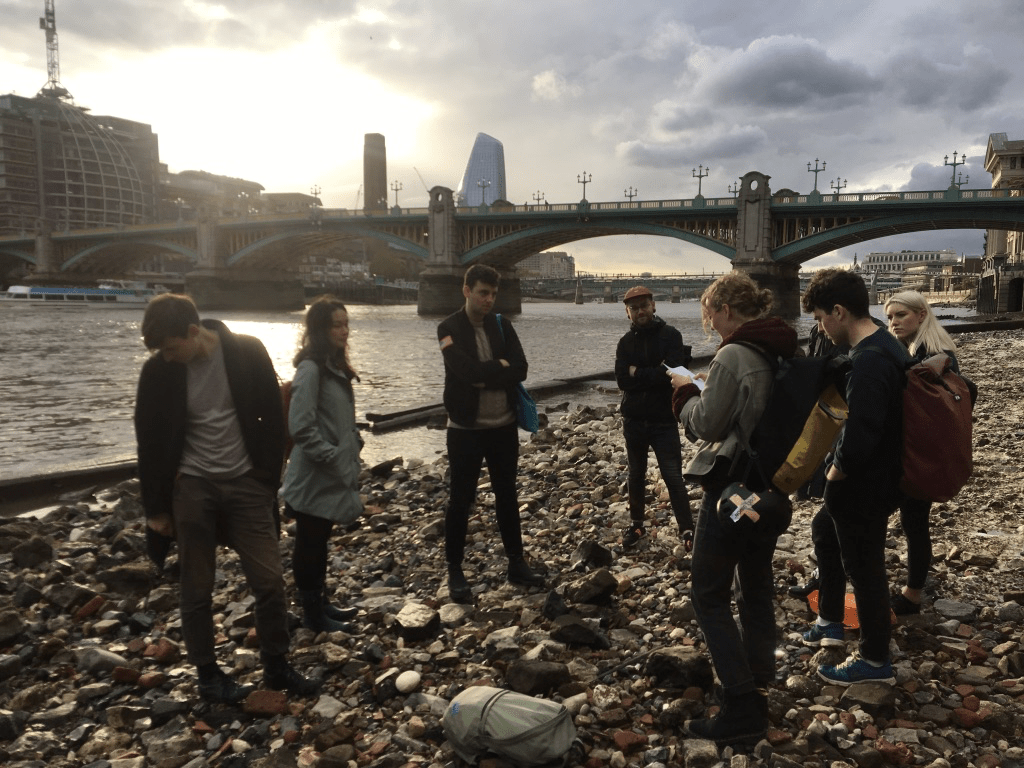
HT6 has consistently facilitated a dialogue around questions of ecological experience, cognition and spatial systems of various scales, materialities and forms (including ‘architecture’). This year we will trace an ecological calculus through some situated field-based engagements. Primarily, we will seek to really encounter the River Thames, as some kind of a being, from five points of view: Ecology; Aesthetics; Semiotics, Law, Labour.
We will have a series of situated readings, documentations and dialogues, at various locations on the Thames, looking at texts, films and other artefacts, drawing upon ecological theory, environmental rights and justice, cognitive science, cybernetics, Marxist and feminist materialisms, and science and technology studies, and we will explore their often complex co-development with thinking about architecture, cities and spaces.
Declared dead in the 1950s, the Thames is once again home to many diverse ecosystems, and complex hybrid ecological and structural relations with our own spieces-practices. Just a few thousand years ago London’s river – known locally as Father Thames – fed into a vast Thames-Rhine European river delta which now sits below the North Sea – and which is now dredged to provide aggregate for reincarnation into British and European construction projects. The origin myths of London are strange and submerged – involving two giants, Gog and Magog, and Brutus of Troy – but we can at least be certain that the river provided essential affordances for the emergence of the city of Londinium as an outpost of the Roman Empire, and has co-evolved with the city over the millennia since.
We will have a series of situated readings, documentations and dialogues, at various locations on the Thames, looking at texts, films and other artefacts, drawing upon ecological theory, environmental rights and justice, cognitive science, cybernetics, Marxist and feminist materialisms, and science and technology studies, and we will explore their often complex co-development with thinking about architecture, cities and spaces.
Dr Jon Goodbun trained as an architect, and is a researcher, practitioner and educator at the RCA (MA Environmental Architecture), the University of Westminster (Msc Advanced Environmental Design), and the Bartlett (MArch). His research focuses on the intersection of ecological theory, cybernetics, cognitive science and urbanism. He is experimenting with informal teaching with Rheomode and Derailed. Recent publications include Scarcity: Architecture in an Age of Depleting Resources (Wiley) and Design of Scarcity (Strelka). He can be found online at www.rheomode.org.uk and twitter: @jongoodbun -
On the Possibility of an Ecological Dialogue
This is a short piece that I wrote for the Making Futures and Climate Care summer schools in Berlin’s Floating
Universityand Haus der Statistik, running summer 2019, On the Possibility of an Ecological Dialogue
-
‘Inter-Temporal Ecologies: In More Than Human Worlds’ at Arts Catalyst, London

I’ve had the pleasure of helping to set up two of the most important masters courses in environmental design and architecture in London in recent years. First was the MSc Architecture and Environmental Design at the University of Westminster – an excellent technically-driven course details here. More recently I helped to set up the MA Environmental Architecture at the Royal College of Art – a very different kind of course organised around much more multi-scalar geopolitical agendas details here.
A few weeks ago we had the first exhibition of the MA Environmental Architecture -Inter-Temporal Ecologies: In More Than Human Worlds – in collaboration with the wonderful Arts Catalyst Centre for Art, Science & Technology
We presented three days of exhibition, performances, workshops and discussion – I chaired two sessions: on kinship, and water.
Intertemporal Ecologies: In More Than Human Worlds celebrates the work of the inaugural cohort of MA Environmental Architecture, Royal College of Art, exploring the future of environments, landscapes and ecosystems. It presents elements selected from the body of work produced collectively and individually over the last 15 months.
The research focuses on the environmental and territorial disputes resulting from the extraction on lithium in the Salar de Atacama, in Chile: on the one side lithium emerges as a key component in the global pathways to mitigating climate change; and on the other, its extraction results in the appropriation of water – a living being at the heart of fragile ecosystems and indigenous territories.
The work presented reflects upon the role of design and architecture at the intersection of these incommensurable demands, while recognising the complex system of relationships and entanglements they are part of. The exhibition brings together the dynamic cycles of both mental, social and material ecologies that inform diverse relationships between human, non-human and other than human beings. Through a programme of workshops, talks and conversations the event will explore the past, present and future of environments as more than human worlds.