a research practice led by dr jon goodbun, working at the intersection of architecture, technology, art and ecological pedagogy. based in athens and london
I am giving a paper at the concluding symposium of a lecture series on ‘Critical Urban Ecology’ organised by Karin Jaschke at the University of Brighton – together with Doug Spencer and Ross Adams. I know Doug well from Westminster – where we both teach (and finish PhDs) and the AA, where he organises the theory component of the interesting Landscape Urbanism MA. I have not met Ross Adams before, but I recommend his excellent recent critique of ‘Eco-Cities’ in Radical Philosophy journal.
I will be first on and will give an overview of some concepts taken from ecology and in particular the development of the concept of metabolism in Marx and recent urban political ecology. I will briefly consider how metabolism has been theorised in neocybernetics, and will suggest how some ideas taken from Gregory Bateson might inform the development of these ideas today.
I happened to pass London Stone a few days ago. It was looking even more forlorn that normal. London Stone (it curiously does not generally take a definite or indefinite article) has been situated behind dirty glass and a clumsy grill, semi-hidden below the pavement of 111 Canon Street, for nearly forty years. The text on a plaque above the grill states:
‘London Stone: This is a fragment of an original piece of limestone once securely fixed in the ground now fronting Canon St Station. Removed in 1742 to the north side of the street in 1798 it was built into the south wall of the Church of St Swithin London Stone which stood here until demolished in 1962. Its origin and purpose are unknown but in 1188 there was a reference to Henry, son of Elwin de Londonstone, subsequently Lord Mayer of London.’
London Stone by Jon Goodbun
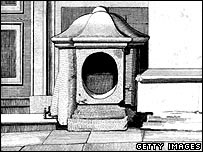
In fact, more is known about the stone than that, and still more speculated. Referred to by Shakespeare, Blake and Dickens (‘that curious relic of old London’), the most widely disseminated story seems to be that London Stone was put in place during the time of the Romans, and it was the point from which they measured distances from Londinium (i.e. it was a milliaria or milestone). Although there is no indisputable direct proof that this was the case, there seems to be substantial circumstantial evidence that it is indeed ancient. There are a series of legends that date the stone at around 3000 years old. Some of these claim it as a Druid stone, part of a circle that stood at Ludgate (the burial site of King Lud in the first century BC), on the current site of St Paul’s Cathedral (this account was favoured by Blake). Certainly, this is one of the oldest settled parts of London. Cannon St flanks St Paul’s and becomes Ludgate Hill running west from the current St Swithin’s site of the stone, and nineteenth century excavations at the side of Cannon St station found significant pre-Roman walls.
Another legend claims that the stone is the Stone of Brutus, and was a part of an altar of a Temple of Diana, built by Brutus on the hill where St Paul’s now stands. According to this legend, the city of London was first founded around 1070 BC (as ‘New Troy’, ‘Troia Newydd’ or ‘Trinovantum’) by Brutus of Troy, who (according to legend) was sent to Albion with the Britons by the godess Diana. According to this legend Brutus defeated a race of giants led by Gog and Magog on the Thames (there are statues of these two at Guildhall, and now as guardians of London they still lead the Lord Mayor’s parade each year). There is an old proverb that states ‘So long as the stone of Brutus is safe, so long shall London flourish’.
London Stone in 18th century from BBC (below)
During the middle ages there is some evidence that London Stone played an important civic and political role, and was the site at which laws and oaths were passed or announced to the people of London. It was perhaps for this reason that in 1450 Jack Cade (also known as Mortimer and Aylmere), leader of the Kent peasants revolt against Henry VI, marched from their meeting place on Blackheath, and declared himself ‘lord of the city’ at London Stone, striking it with his sword. This was dramatised by Shakespeare in Henry VI Pt II, wherein Cade was also given the fantastic lines ‘The first thing we do, let’s kill all the lawyers.’
LondonStone from Heartfield (below)
The stone is a fragment of a bigger stone, which may still be located below the pavement of Canon Street – there are repeated references to the current fragment being relocated to the wall of the Wren’s St Swithin’s London Stone church after the Great Fire, as part of a widening of Canon Street. Equally, it may well have gradually reduced in size as pieces of it were taken for occult use. It would seem that Dr John Dee, the alchemist of Elizabethan London, certainly took pieces of the stone to experiment on.
London Stone and its associated cast of characters has appeared in the texts of centuries of London writers. Beyond Shakespeare, Blake and Dickens, John Dee became the main protagonist in Peter Ackroyd’s 1993 novel ‘The House of Doctor Dee’, a story which referenced Michael Moorcock’s ‘Mother London’ myth of a troglodytic race of Londoners. Similarly, the geomantic aspects of the stone’s history – highlighted in 2002 by a ‘Reclaim the Stones’ march that paid their respects at London Stone before making their way to St Paul’s to demand the demolition of the cathedral and its replacement with a stone circle (it is reputed to be the point at which leylines cross) – found echoes in Iain Sinclair’s work in particular.
London Stone in church wall before the Blitz (from BBC below)
The tendency of this recent generation of London writers to dwell upon arcane and speculative moments in the city’s past provoked James Heartfield to argue in a Blueprint magazine article back in 2004 that this writing was nostalgic and reactionary, and needed to be understood as the mythic correlate to processes of gentrification in London during this period. There is something of substance to this analysis, to be sure, and as Heartfield notes, it can be particularly useful in understanding Ackroyd’s work. However, there are problems with other aspects of Heartfield’s analysis that are worth briefly revisiting today.
The adoption of the Situationist International based psychogeographic strategies by Iain Sinclair in particular is singled out by Heartfield. He suggests that psychogeographic dérive is similar to the wandering of the flaneur famously described by Walter Benjamin, and is characteristic of leisure classes. And in a sense of course he is right. However, it is important to identify the differences here. The wandering of the flaneur describes a distinctly bourgeois and consumerist wandering (Benjamin himself moved way beyond a flaneur subjectivity in his own research on the city in ‘Passagenwerk’). The situationists describe the dérive in very different terms, and in particular Guy Debord emphasises that this is not some subjective exercise, but is rather a search for an “objective” and “ecological” knowledge of the city. In fact, Heartfield’s general argument might be better supported by asserting that Sinclair (and associated self ascribed psychogeographers such as Will Self) are better critiqued as not situationist (ie objective) enough, primarily as they tend to dérive alone. In the ‘Theory of the Dérive’ Debord asserts that
“One can dérive alone, but all indications are that the most fruitful numerical arrangement consists of several small groups of two or three people who have reached the same level of awareness, since cross-checking these different groups’ impressions makes it possible to arrive at more objective conclusions.”
I would concur with Heartfield that there is a need for suspicion regarding some of the myths of organic continuity that can characterise Ackroyd’s work – he is right that these kinds of fictional-mythic histories can easily play into the hands of conservative forces of all kinds – particularly when it shifts from London to Albion. However, Heartfield seems to reject the possibility of any useful creative work with our history, and that seems somewhat excessive. Whilst there is a populist element to these histories, the role that they play in the imagination is not so easy to pin down. More generally, it could be argued I think that the resonance of London history is as much to do with a growth in urban consciousness in opposition to national awareness, as it does with nostalgia per se. Writers like Iain Sinclair arguably produce a difficult mythic narrative imaginaries, which are not unrelated to surrealism (in the service of the revolution) in this regard. Whilst Benjamin is perhaps too often appealed to when discussing these questions, but he does notably argue for the possibility that old objects and histories contain objective surreal and revolutionary potential, precisely because they come from a different London. It seems crazy to abandon this imaginary space to the right, and I look forward to a future revolutionary role for London Stone!
London Stone with Chris Cheek in his shop
Curiously, the stone was nearly lost a few years ago before being rescued from builders by Chris Cheek! It may yet suffer that fate… when I passed it the building was empty again, possibly awaiting demolition… keep an eye on it..
I have spent the last few days with Karin working on a paper for André Viljoen and Katrin Bohm’s conference AESOP 2ND EUROPEAN SUSTAINABLE FOOD PLANNING, which will be hosted by University of Brighton later this month. I have posted our paper abstract below.
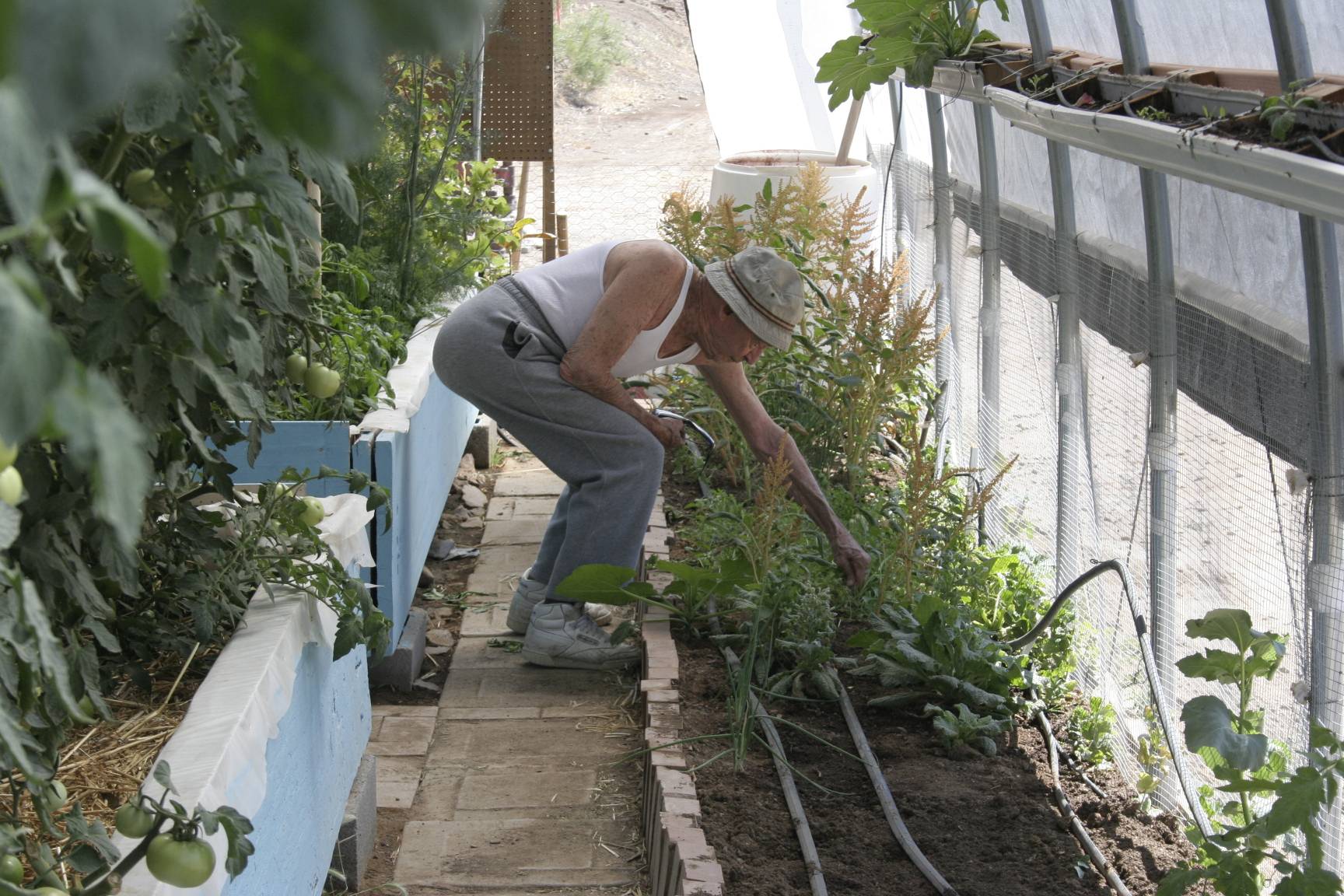
Paulo Soleri in Arcosanti greenhouse picking food, May 2010 (by author)
The Ecological Aesthetics of Food Production at Arcosanti
Jon Goodbun and Karin Jaschke
In this paper we will explore ‘paradigms and strategies for urban and rural planning and design’, and ‘definitions of sustainable metropolitan agricultural systems’, using as a case study the recently revived plans for food production at Arcosanti. We will use new and previously unpublished on-site interviews and documents to discuss these developments, as well as reflecting upon Paulo Soleri’s distinctive methods of ‘scenario building, visioning and public engagement’. In discussing these matters, we will draw upon a somewhat forgotten 1970 paper by Gregory Bateson –Restructuring the Ecology of a Great City– arguing that following Bateson, we must not think of food systems as solely energy and material flows – progressive though this would be. Rather, food ecologies are as much to do with communication and information flows, and can only be properly grasped through what Bateson described as an ecological aesthetics.
The complex challenges faced by the historical and ongoing development of Arcosanti reflect contradictions within the urban food movement more broadly. Whilst much of the recent discourse around urban food production assumes that any such developments will necessarily be based in grassroots, socially progressive ‘grow your own’ and ‘transition town’ type initiatives, facilitated by designed organisational systems (planning) of one kind or another, this will not necessarily be the case. Indeed, one can presume that if there is any sense to urban food production at all, then the normal forces of capital accumulation will soon get to work. Indeed, many of the more recent proposals that are emerging within the architectural imaginary are precisely of this form, for example the vertical farms which by definition require significant capital investment, and are no doubt based upon private ownership of production.(1)
In fact, whilst generally seen as a critical of the forces of capitalism, the progressive character of the transition town type model is itself by no means uncontested. There are important reasons to be suspicious of the ideology that can be found lurking not far beneath the surface of many ‘return to localism’ movements. For example, in a recent article Andy Fenwick has argued that the Transition Town type strategies entail, from one kind of Marxist perspective at least, multiple problems including: a confused appeal to a mythical past, exporting unemployment to developing countries, reliance upon local currencies acting as local trade barriers, and cheap labour.(2) More importantly, these movements can easily be accused of false consciousness – that is to say, giving the appearance of radical change, whilst actually diverting energy away from confronting the real and fundamental source of environmental and economic crisis: capitalism itself.
Nonetheless, the ‘metabolic rift’ described by Marx has never been so alarming, and the need for a radical cultural re-conceptualisation of our food systems would seem to be undeniable. Transition culture can rightly claim that the very real instability of capitalism in the contemporary period, and the very real possibility of near future resource wars, and/or a collapse in global trade, demands a robustness to food production that only local knowledge and production networks can provide.
We will explore how these broader socio-economic contradictions might be reflected in the experimental setting of Arcosanti, and suggest how a conception of ecological aesthetics might help make visible the multiple levels of consciousness – both radical and false – that all of these experiments necessarily project.
(1) See for example http://www.verticalfarm.com/. In Detroit, as has been well documented, grassroots initiatives (see for example http://www.urbanfarming.org/) are being challenged by larger scale commercial propositions (http://www.hantzfarmsdetroit.com/). There is an emerging distinction, between urban farming proposals that stage and experiment with new social forms and new relations to nature, and those that are simply vehicles for private capital investment and profit.
The text below was a short discussion piece produced for the research project SCIBE (Scarcity and Creativity in the Built Environment). This research project is just a few months old, having been awarded funding by EU HERA. Jeremy Till is the Principle Investigator, and University of Westminster the lead institution. I contributed to the original research funding bid earlier this year (for €1M), and am engaged for around a day a week for the next three years, working on the project. The project web site is www.scibe.eu, although there is not much there yet!
Scarcity: Reality and Ideology
Scarcity is both a reality, and an ideology (a complex term, which I use here in the classic marxian sense of ‘false consciousness’).
There is a system of production (capitalism.) Real ‘scarcities’ play real roles in that system.. ie there are real material and energy flows, which ultimately have a combination of natural and social foundations. At any one time there are limits to these flows – ie there are real scarcities.
In addition, the concept of scarcity plays an ideological role. That is to say, it naturalises (it makes obscure) the socialcomponent of the limits of these flows: Those elements of the limits (at any given time) to material flows which are social in nature- ie determining who gets what proportion of the available materials and energy is according to a range of social constructs such as money, location, nationality – are obscured, and made to look inevitable, natural, the democracy of the market etc
This is compounded when it is realised that those in the system who own and manage these flows have a vested interest in maintaining scarcities. Scarcities, the control of resources, are real social power. (In energy supply for example, big power companies are most obstructive to local generation, and most supportive of nuclear. And as I think Bookchin noted, a wind farm owned by a multi-natational power corporation is not an alternative technology!)
Scarcity works dialectically with abundance, as the same system, at the same time as producing scarcity in the ways described above, also constructs ‘abundance’ as both a reality and an ideology. Most notably here, promoting the false consciousness that we can extract as much as we want from the planet… so, we literally get hit conceptually I both directions… and this keeps people confused!
In both cases then, the key ideological role is to obscure the real workings of the system – and to make it seem natural, incomprehensible etc etc
So, where does design and creativity fit in? Well, designed objects and built environments play important roles in maintaining both of these concepts (and researching that role is one of the aims of this project.) Designed objects and environments often obscure their conditions of production, and also obscure the flows that they are a part of. Design and creativity. (which we could define as specific forms of self consciousness?), are contained within particular divisions of labour.
So, we say that we want to critique the existing limiting division of labour that keeps creativity perpetuating a logic of scarcity, and we promote new expanded forms of creativity and design, that seek to both resolve the reality of scarcity, and expose the ideology of it. In both cases, this is achieved through a making visible and ‘democratic’ the ecology of economic flows through an extension of design (!!)
Instead of only saying that we accept scarcity, do we simultaneously say that we refuse it? Or perhaps we say that we accept it as we want to take control of it? Do we argue that scarcity is going to become an increasingly political term, and that we want to reveal the full meaning of the term?
Is the design task an ideological critique (in the sense of Tafuri) of the hidden conceptualisations of scarcity in existing design practices. Would an ideological critique look at different approaches and ask, in what ways are these design practices increasing false consciousness around the system of production? In what ways could they be revealing the networks and flows, or facilitating democratic ‘local’ control (and indeed ultimately ‘global’ control) of aspects of these systems, etc? What would the introduction of second order cybernetic, systems theory and ecology concepts bring to such a critique and practice?
Last year (2009-10) I ran a post-graduate diploma studio at University of the Creative Arts, Canterbury. This project by Chris Jennings-Petz was submitted by the school to the RIBA Presidents Medals competition.
Ashford, an old Kent industrial/market town on the Stour river complex, plans to double in size over the next two decades, with 30,000 new homes. However, although Ashford has recently plugged-in to international rail networks, the town has remained formless, indistinct, unconscious.
Research started with a mapping of the Ashford landscape as a metabolic entity, defined through demographic, infrastructural, economic, geological and urban flows. Forming what Bateson called “an ecology of mind”, this allowed intriguing insights into socio-geographical processes. Work soon focused upon socio-geological water flows, and included a novel report into the embodied water of building production. Through his regional analysis, major weaknesses were found in the city’s water planning. This issue defined the design strategy remit and project thesis.
The hydrological, agricultural and geological surveys revealed a band of clay and aquifer running below the city. In an ingenious move, Chris chose this as the (sub)site, and proposed to excavate a string of region/city-defining reservoirs passing through the urban centre, slowly filling to meet the expanding water requirement. The waterside edges create a series of new urban landscape conditions, transforming land values, and introduce a new metropolitan space, and metabolic relation, into the heart of Ashford.
A reservoir infrastructure was elaborated through a strong leisure programme, incorporating an ultra deep diving well, surface sports, a new ecological corridor with urban food production potential, and hundreds of floatation tanks. At the core of the scheme, the landscape both mounds, and drops to deep vertical wells, countering Ashford’s dominant horizontality. This move transforms the topography of the city, and perhaps reconfigures the cognitive maps of the city, in the inhabitants’ imagination.
Working across scales, strategic regional moves were paralleled with 1:1 material prototypes that crystallised a series of open-ended experiments involving salt solutions and clay castings of various kinds. Samples and apparatus accreted around Chris’ drawing board through the year, defining a metabolic aesthetic. His evolving installations animated the diploma studios, whilst the proposal staged a urban landscape infrastructure, as a new ecological domain of social experience.