Category: ecology

  • Design Ecologies Symposium at Architectural Association

    I will be giving a paper at the Design Ecologies Symposium at the Architectural Association, London, on February 4th. The line up for the day is as follows:

    Design Ecologies: The Unprimed Canvas

    1030  Ideation

    Kate Davies and Shaun Murray

    1100  Ecological Design Visions

    Visionary thinking on methodologies of communicating an architecture along with new models and ecological contribution.

    Shaun Murray (Eniatype, London)

    Jon Goodbun (University of Westminster, London)

    Timothy Morton (UC Davies, California)

    1200  Notational Design Visions

    Notational systems within architectural education used as a communication tool have made the composition of architecture an activity like the composition of fiction: the activity of communication.

    Mathew Emmett

    Kate Davies/ Emmanuel Vercruysse (Liquid Factory)

    Bastian Glaessner (Lynn Fox, Blink productions)

    Coffee Break

    1330  Instructional Design Visions

    There are many kinds of relationships between participant and environment within context, design and communication. An extremely important one is who communicates with whom and who instructs whom.

    Benedict Singleton

    Kjell Yngve Petersen (IT Copenhagen)

    Felix Robbins (Make Architects, London)

    1430  Aesthetical Design Visions

    Aesthetic experience is one of the most common ways to value our environment. Whether it is having a walk in the park, cycling through a country lane, or just sitting in your garden, we can appreciate the aesthetic qualities. We could go on to say that we should be developing environmental sensitivity through aesthetic experience.

    Claudia Westermann

    James Moore (University of Falmouth)

    Bruce McLean (Bruce Mclean, London)

    1530  Discussion

    Through original design exploration, this symposium proffers a critical vision towards the built environment. These conceptions challenge the everyday education of architectural design by offering a transdisciplinary framework for design production.

    1700  Book launch and drinks

    To subscribe to the peer-reviewed Design Ecologies Journal, please go to the following link: http://www.intellectbooks.co.uk/journals/view-Journal,id=197/

    For more information please contact: info@eniatype.com

  • Neocybernetics – Sketches of Another Future: review in Radical Philosophy 165

    I have a new article in the new issue of Radical Philosophy, a double book review of Bruce Clarke and Mark B.N. Hansen (eds.), Emergence and Embodiment: New Essays in Second-Order Systems Theory (Duke University Press, Durham, NC, 2009), and Andrew Pickering, The Cybernetic Brain: Sketches of Another Future (University of Chicago Press, Chicago and London, 2010).

    Both books are of interest. The Clarke and Hansen collection contains important pieces by the two editors, together with a mix of works from contemporary and canonic thinkers in the field, including Francisco Varela, Niklas Luhmann, Heinz von Foerster, Evan Thompson, and John Protevi, amongst others. The broad drive of the collection, for the editors, is that:

    “it is only by theorising the operational closure of cognizing systems that cultural theory can rescue agency – albeit agency of a far more complex variety than that of traditional humanism – from being overrun by the technoscientific processes that are everywhere transforming the material world in which we live today.. Better late than never, second-order cybernetics can now perhaps finally come through on its promise to provide the ecology of mind best fitted to the demands of our intellectual, institutional, and global crises.”

    I am particularly fond of Andrew Pickering’s new work. I first met him in February last year, when we were both speaking at a symposium at the University of Nottingham, organised by their Science Technology Culture Research Group, and was not aware of his work before then (although I probably should have been). Pickering shares an interest in the same collection of cyberneticians that have animated sections of my PhD research, although he has been able to articulate better than I could, why they were interesting. His move is simple. He basically rejects, or perhaps just ignores, the first-order/second-order distinction that characterises most accounts of cybernetics, and instead describes a radical tendency within cybernetics of ‘anti-control’, almost exclusively composed of British researchers. This would be as opposed, I guess, to a more mainstream and American/German systems theory of ‘control’. Pickering – a former quantum physicist turned historian/theorist of science – has written about the social forms of scientific practice, and the effect of these forms upon the knowledge claims made by science. Importantly for Pickering, “the ontology of cybernetics is a strange and unfamiliar one, very different from that of the modern sciences”. He argues that the modern ideology of science is fundamentally representational, and claims that the experimental work of British cybernetics (in which he includes Gregory Bateson, R.D. Laing, Stafford Beer, Gordon Pask, Ross Ashby, and Grey Walter) stages a non-representational approach, a “hylozoic wonder”, and a “reciprocal coupling of people and things” and “an understanding of science as a mode of performative engagement with the world.” Pickering describes how radical cybernetics stages what he calls “ontological theatre”. In Pickering’s account, we find a distinctive and radical outline for a new “nomadic science”, a “forward-looking search … [for] a vision not of a world characterised by graspable causes, but rather of one in which reality is always ‘in the making’.”

    In the review, I argue that both books move beyond the dominant critique of cybernetics that emerged in recent decades, perhaps most energetically found in the French group Tiqqun’s Cybernetic Hypothesis. I conclude (all too briefly – but see my forthcoming PhD and elsewhere for a more extended argument), that in these accounts of radical/neo-cybernetics, there can be found an important critical contribution to the renewed interest in the concept of metabolism, that has developed in recent Marxian theories of  Urban Political Ecology and Landscape Urbanism.

    I have recently found this interview with Andrew Pickering on the University of Nottingham’s Science Technology Culture Research Group website, which gives an accessible introduction to his thinking:


    NB I have another article where I consider Pickering’s work and the question of interactive design, on the Creative Applications Network.

  • AD: The Scarcity Report

    I am very happy to announce that I have recently been given approval to guest edit (with Jeremy Till and Deljana Iossifova) an edition of the Wiley journal Architectural Design (AD), by commissioning editor Helen Castle. The issue has the working title ‘The Scarcity Report’.

    I have attached below the main sections of the book proposal, which may be of interest – both for the actual proposal, but also as information for other potential guest editors, regarding the proposal process. There were sections concerning my previous publications and biography, which I have removed (as they are located elsewhere on this site). I have also removed some details regarding indicative contributors, as I am now in the process of approaching likely suspects. The proposal was ‘anonymously’ refereed and reviewed by Neil Spiller, Susannah Hagan and Anne Thorpe, all of whom made very useful suggestions, and were generally positive.

    AD: The Scarcity Report

    Guest Editor: Jon Goodbun with Jeremy Till and Deljana Iossifova

    1. Proposed Title:

    The preferred title is The Scarcity Report. The word ‘report’ is intended to indicate that the publication is a direct summary of a pressing issue and, in the manner of an official report, will provide pointers as to how address the global condition of scarcity. It also refers to the seminal publication “Limits of Growth” which was conceived of as a report to the Club of Rome.

    2. Full name of guest-editor and affiliations:

    Jon Goodbun

    University of Westminster Senior Lecturer

    EU HERA funded SCIBE (Scarcity and Creativity in the Built Environment) researcher

    Jon Goodbun will be supported by an editorial advisory group led by Professor Jeremy Till and Dr Deljana Iossifova, also at the University of Westminster, who are the lead researchers in a major EU research project based around issues of scarcity and creativity in the built environment.

    3. Outline of definition of theme:

    We are today in the midst of a ‘perfect storm’ of social, political, economic and ecological dimensions. The full extent and severity of our current conditions are yet to be determined, but one thing seems certain – our foreseeable futures will not be like our recent pasts. Leading analysts of all the major resource domains – water, food, material, energy and finance – all tell us that our global industrial growth models driven by the irrationality of financial market speculation are taking the planet to the brink of a series of chronic scarcities. Some of these are determined by real natural limits in terms of diminishing quantities of mineral resources. Other scarcities are based upon our problematic mis-management of natural flows of resources such as water, timber and food (both animals and agriculture). Many others still are simply based upon the socially and geographically uneven  development and distribution of these flows, with a transfer of real metabolic value from the poor to the rich areas of the globe. In parallel to these metabolic inputs, industrial economies are also externalising – in a generally catastrophic manner – all kinds of waste sinks. Again this is characterised by an uneven development, typified by flows of waste from rich to poor regions. In all of these cases, existing systemic stresses are expected to transform and intensify in unpredictable ways as a result of climate change and ecosystem shifts. Scarcity, both actual or constructed, has been largely suppressed as topic in recent debates, which have centred around the more emollient term ‘sustainability’. However, there is a rising interest in scarcity as potentially the central feature of societal change in the coming decade.

    Architectural, urban, planning and design research has multiple forms of engagement with these issues, from developing new forms of analysis of global flows and scarcities, to specific local and global design based responses. In all cases, a full engagement with these issues has the capacity to completely reconfigure design practices in new, radically post-sustainable, directions The Scarcity Report will make a major contribution to these developments, and will be welcomed by architectural and design practitioners and theorists, and by activists and entrepreneurs more broadly.

    4. Outline of treatment:

    The Scarcity Report will be organised according to three axes: design research, concepts of scarcity, and ecological scale. Overall there will be an equal weighting between the brute ecological and economic facts, design theory, and practical design case studies.

    The three sections will in turn be broken into three categories, as follows:

    Design Research:

    This section will explore the way that designers have employed various strategies to analyse, document or design under conditions of scarcity:

    a: design theory and future scenario planning

    b: design research as analysis and explanation of existing conditions, promoting ecological literacy.

    c: design research as proposing and testing solutions: design strategies, activism, case studies

    Concepts of Scarcity:

    This section will look at the ways in which scarcity presents itself:

    d: natural scarcity

    e: social scarcity

    g: architectural/design scarcities

    Ecological Scale:

    This section will show how scarcity is addressed at three different scales:

    h: local

    i: regional

    j: global

    5. Selling Points:

    1: The Scarcity Report discusses a topic that is too pressing to overlook, but which has been very under-theorised. It will be the first major publication to address the issue.

    2: The Scarcity Report transforms the contemporary discourse around ecological design, defining a distinctly post-sustainable position. This will mark the publication as a new direction for theoretical and practical debate.

    3: The Scarcity Report will be the first time a collection of leading theorists, designers, researchers, projects and activists have been brought together in one publication (for example John Thackara, Ezio Manzini, Michael Braungart, Erik Swyngedouw, Jeremy Till). This will be significant and referred to.

    4. The Scarcity Report extends a new strand of ADs that are addressing important global issues.

    5. The Scarcity Report will make explicit connections between the background theory and design action

    6. Typical profile of readership:

    The Scarcity Report will be read across architecture, planning, landscape, product and systems design, by educators and students, activists, young practitioners and small practices within and beyond design, The Scarcity Report will also provide an importance reference within the ‘sustainability’ discourse, for community groups, policy makers and thought leaders.

    9. Description of reason for publishing:

    Whilst there has been work done on systems design, by contributors such as John Thackara, Ezio Manzini, and Michael Braungart, this thinking has been focused more at product design, and is not at all well disseminated in architecture. Students are however now demanding it. Equally, new forms of design activism that are starting to emerge in architecture schools, and new forms of systems analysis that can only come out of a basis in urban and landscape theory (Jon Goodbun), is of increasing interest to designers at large. The new forms of critical geography based on concepts such as urban metabolism, and urban political ecology (Erik Swyngedouw, David Harvey etc) are of great and growing interest to students and researchers across architecture, planning and design. This publication is the first time that these three areas have been brought together, together with a set out of the basic facts concerning global resource flows.

    The  material will also provoke a self-reflexive consideration of the forms of practice and professional organisation in architecture and design (Jeremy Till), and so will provide the means for young practitioners to position themselves in new ways as activists, researchers and entrepreneurs.

    10. Indicative Table of Contents:

    Editorial/Introduction: Jon Goodbun

    Ecological and Economic facts: including The Socio-Ecological Production of Scarcities, Supply Systems, Metabolism, Resilience and (Urban and Regional) Planning

    Post-Sustainable Design Theory: including Design Activism, Rethinking forms of design practice and education, Peak Resources and Strategic Design, Future Scenario Planning as design research, Ecological Literacy

    Case Studies: various global examples across scales

  • Critical Urban Ecology: Symposium at Brighton Uni 8th Dec

    I am giving a paper at the concluding symposium of a lecture series on ‘Critical Urban Ecology’ organised by Karin Jaschke at the University of Brighton – together with Doug Spencer and Ross Adams. I know Doug well from Westminster – where we both teach (and finish PhDs) and the AA, where he organises the theory component of the interesting Landscape Urbanism MA. I have not met Ross Adams before, but I recommend his excellent recent critique of ‘Eco-Cities’ in Radical Philosophy journal.

    I will be first on and will give an overview of some concepts taken from ecology and in particular the development of the concept of metabolism in Marx and recent urban political ecology. I will briefly consider how metabolism has been theorised in neocybernetics, and will suggest how some ideas taken from Gregory Bateson might inform the development of these ideas today.

  • The Ecological Aesthetics of Food Production at Arcosanti

    I have spent the last few days with Karin working on a paper for André Viljoen and Katrin Bohm’s conference AESOP 2ND EUROPEAN SUSTAINABLE FOOD PLANNING, which will be hosted by University of Brighton later this month. I have posted our paper abstract below.


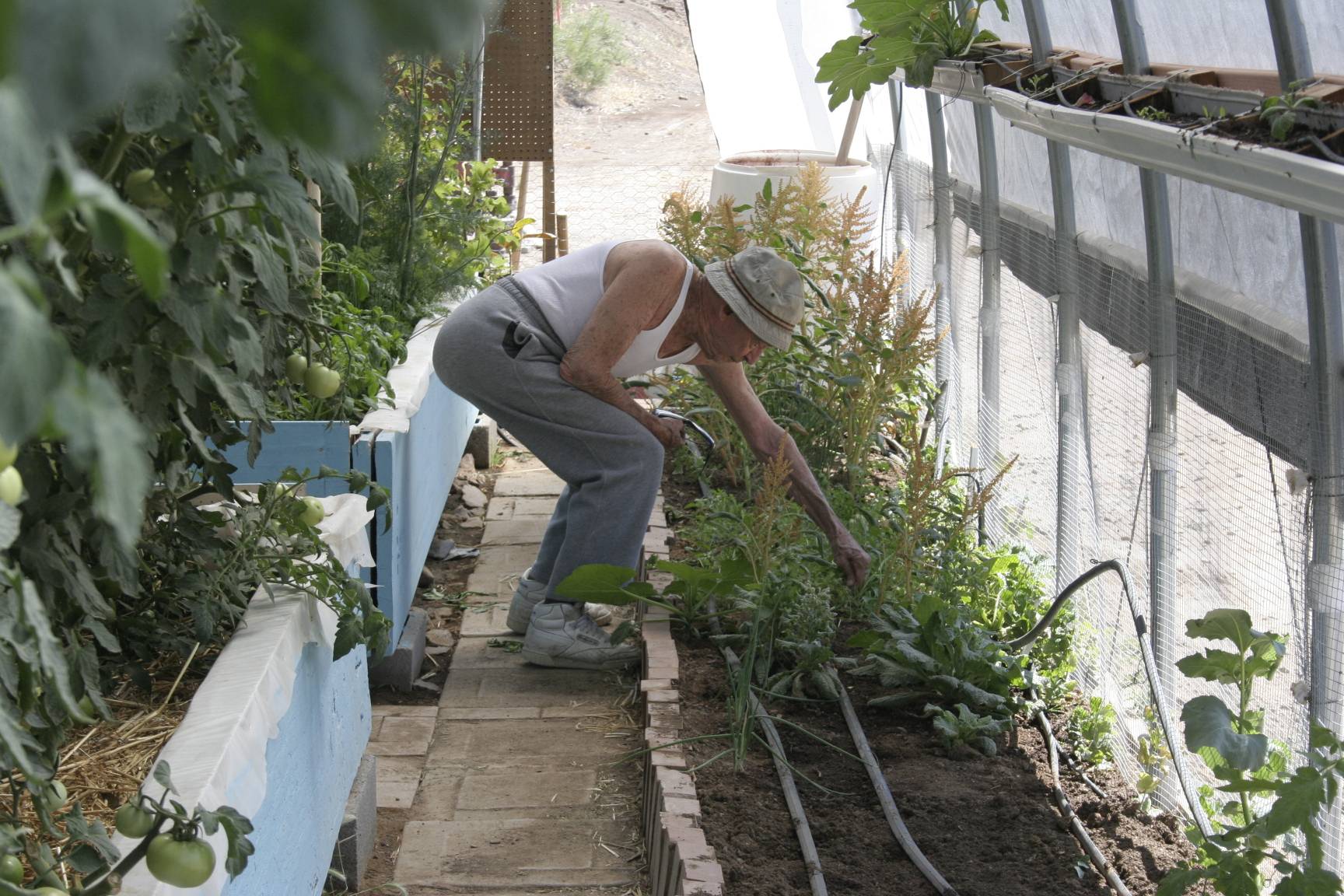
    Paulo Soleri in Arcosanti greenhouse picking food, May 2010 (by author)


    The Ecological Aesthetics of Food Production at Arcosanti

    Jon Goodbun and Karin Jaschke

    In this paper we will explore ‘paradigms and strategies for urban and rural planning and design’, and ‘definitions of sustainable metropolitan agricultural systems’, using as a case study the recently revived plans for food production at Arcosanti. We will use new and previously unpublished on-site interviews and documents to discuss these developments, as well as reflecting upon Paulo Soleri’s distinctive methods of ‘scenario building, visioning and public engagement’. In discussing these matters, we will draw upon a somewhat forgotten 1970 paper by Gregory Bateson – Restructuring the Ecology of a Great City – arguing that following Bateson, we must not think of food systems as solely energy and material flows – progressive though this would be. Rather, food ecologies are as much to do with communication and information flows, and can only be properly grasped through what Bateson described as an ecological aesthetics.

    The complex challenges faced by the historical and ongoing development of Arcosanti reflect contradictions within the urban food movement more broadly. Whilst much of the recent discourse around urban food production assumes that any such developments will necessarily be based in grassroots, socially progressive ‘grow your own’ and ‘transition town’ type initiatives, facilitated by designed organisational systems (planning) of one kind or another, this will not necessarily be the case. Indeed, one can presume that if there is any sense to urban food production at all, then the normal forces of capital accumulation will soon get to work. Indeed, many of the more recent proposals that are emerging within the architectural imaginary are precisely of this form, for example the vertical farms which by definition require significant capital investment, and are no doubt based upon private ownership of production.(1)

    In fact, whilst generally seen as a critical of the forces of capitalism, the progressive character of the transition town type model is itself by no means uncontested. There are important reasons to be suspicious of the ideology that can be found lurking not far beneath the surface of many ‘return to localism’ movements. For example, in a recent article Andy Fenwick has argued that the Transition Town type strategies entail, from one kind of Marxist perspective at least, multiple problems including: a confused appeal to a mythical past, exporting unemployment to developing countries, reliance upon local currencies acting as local trade barriers, and cheap labour.(2) More importantly, these movements can easily be accused of false consciousness – that is to say, giving the appearance of radical change, whilst actually diverting energy away from confronting the real and fundamental source of environmental and economic crisis: capitalism itself.

    Nonetheless, the ‘metabolic rift’ described by Marx has never been so alarming, and the need for a radical cultural re-conceptualisation of our food systems would seem to be undeniable. Transition culture can rightly claim that the very real instability of capitalism in the contemporary period, and the very real possibility of near future resource wars, and/or a collapse in global trade, demands a robustness to food production that only local knowledge and production networks can provide.

    We will explore how these broader socio-economic contradictions might be reflected in the experimental setting of Arcosanti, and suggest how a conception of ecological aesthetics might help make visible the multiple levels of consciousness – both radical and false – that all of these experiments necessarily project.

    (1) See for example http://www.verticalfarm.com/. In Detroit, as has been well documented, grassroots initiatives (see for example http://www.urbanfarming.org/) are being challenged by larger scale commercial propositions (http://www.hantzfarmsdetroit.com/). There is an emerging distinction, between urban farming proposals that stage and experiment with new social forms and new relations to nature, and those that are simply vehicles for private capital investment and profit.
    (2) See Andy Femwick, ‘Transitional Communities – a dead end for the environment’ in Socialist Appeal, accessed from http://www.marxist.com/transitional-communities-dead-end-environment.htm
  • Scarcity: Reality and Ideology

    The text below was a short discussion piece produced for the research project SCIBE (Scarcity and Creativity in the Built Environment). This research project is just a few months old, having been awarded funding by EU HERA. Jeremy Till is the Principle Investigator, and University of Westminster the lead institution. I contributed to the original research funding bid earlier this year (for €1M), and am engaged for around a day a week for the next three years, working on the project. The project web site is www.scibe.eu, although there is not much there yet!

    Scarcity: Reality and Ideology

    Scarcity is both a reality, and an ideology (a complex term, which I use here in the classic marxian sense of ‘false consciousness’).

    There is a system of production (capitalism.) Real ‘scarcities’ play real roles in that system.. ie there are real material and energy flows, which ultimately have a combination of natural and social foundations. At any one time there are limits to these flows – ie there are real scarcities.

    In addition, the concept of scarcity plays an ideological role. That is to say, it naturalises (it makes obscure) the socialcomponent of the limits of these flows: Those elements of the limits (at any given time) to material flows which are social in nature- ie determining who gets what proportion of the available materials and energy is according to a range of social constructs such as money, location, nationality – are obscured, and made to look inevitable, natural, the democracy of the market etc

    This is compounded when it is realised that those in the system who own and manage these flows have a vested interest in maintaining scarcities. Scarcities, the control of resources, are real social power. (In energy supply for example, big power companies are most obstructive to local generation, and most supportive of nuclear. And as I think Bookchin noted, a wind farm owned by a multi-natational power corporation is not an alternative technology!)

    Scarcity works dialectically with abundance, as the same system, at the same time as producing scarcity in the ways described above, also constructs ‘abundance’ as both a reality and an ideology. Most notably here, promoting the false consciousness that we can extract as much as we want from the planet… so, we literally get hit conceptually I both directions… and this keeps people confused!

    In both cases then, the key ideological role is to obscure the real workings of the system – and to make it seem natural, incomprehensible etc etc

    So, where does design and creativity fit in? Well, designed objects and built environments play important roles in maintaining both of these concepts (and researching that role is one of the aims of this project.) Designed objects and environments often obscure their conditions of production, and also obscure the flows that they are a part of. Design and creativity. (which we could define as specific forms of self consciousness?), are contained within particular divisions of labour.

    So, we say that we want to critique the existing limiting division of labour that keeps creativity perpetuating a logic of scarcity, and we promote new expanded forms of creativity and design, that seek to both resolve the reality of scarcity, and expose the ideology of it. In both cases, this is achieved through a making visible and ‘democratic’ the ecology of economic flows through an extension of design (!!)

    Instead of only saying that we accept scarcity, do we simultaneously say that we refuse it? Or perhaps we say that we accept it as we want to take control of it? Do we argue that scarcity is going to become an increasingly political term, and that we want to reveal the full meaning of the term?

    Is the design task an ideological critique (in the sense of Tafuri) of the hidden conceptualisations of scarcity in existing design practices. Would an ideological critique look at different approaches and ask, in what ways are these design practices increasing false consciousness around the system of production? In what ways could they be revealing the networks and flows, or facilitating democratic ‘local’ control (and indeed ultimately ‘global’ control) of aspects of these systems, etc? What would the introduction of second order cybernetic, systems theory and ecology concepts bring to such a critique and practice?

  • Hydrotecture and Urban Metabolism: The Timing of Space

    Last year (2009-10) I ran a post-graduate diploma studio at University of the Creative Arts, Canterbury. This project by Chris Jennings-Petz was submitted by the school to the RIBA Presidents Medals competition.
    Jennings-Petz Ashford Metabolism
    Jennings-Petz Ashford Metabolism
    Ashford, an old Kent industrial/market town on the Stour river complex, plans to double in size over the next two decades, with 30,000 new homes. However, although Ashford has recently plugged-in to international rail networks, the town has remained formless, indistinct, unconscious.
    Research started with a mapping of the Ashford landscape as a metabolic entity, defined through demographic, infrastructural, economic, geological and urban flows. Forming what Bateson called “an ecology of mind”,  this allowed intriguing insights into socio-geographical processes. Work soon focused upon socio-geological water flows, and included a novel report into the embodied water of building production. Through his regional analysis, major weaknesses were found in the city’s water planning. This issue defined the design strategy remit and project thesis.
    The hydrological, agricultural and geological surveys revealed a band of clay and aquifer running below the city. In an ingenious move, Chris chose this as the (sub)site, and  proposed to excavate a string of region/city-defining reservoirs passing through the urban centre, slowly filling to meet the expanding water requirement. The waterside edges create a series of new urban landscape conditions, transforming land values, and introduce a new metropolitan space, and metabolic relation, into the heart of Ashford.
    A reservoir infrastructure was elaborated through a strong leisure programme, incorporating an ultra deep diving well, surface sports, a new ecological corridor with urban food production potential, and hundreds of floatation tanks. At the core of the scheme, the landscape both mounds, and drops to deep vertical wells, countering Ashford’s dominant horizontality. This move transforms the topography of the city, and perhaps reconfigures the cognitive maps of the city, in the inhabitants’ imagination.
    Working across scales, strategic regional moves were paralleled with 1:1 material prototypes that crystallised a series of open-ended experiments involving salt solutions and clay castings of various kinds. Samples and apparatus accreted around Chris’ drawing board through the year, defining a metabolic aesthetic. His evolving installations animated the diploma studios, whilst the proposal staged a urban landscape infrastructure, as a new ecological domain of social experience.