Category: teaching

  • Three new papers on Gregory Bateson and eco-mental systems

    Hopefully I will have time to finish three new (or mostly new) papers for the final deliverable from our Bateson research project (https://www.enactingecologicalaesthetics.com), which will I think be a significant new collective contribution positioning some of Gregory Bateson’s thinking in relation to contemporary questions regarding the challenges facing ecological design, strategy and planning in an era of extreme socio-ecological uncertainty. The abstracts of my three papers:

    Goodbun – Bateson Book Chapters

    Gregory Bateson and the Political

    This paper below has evolved out of an introductory paper of the same name, written for a dialogue panel led by the author with Phillip Gudemmi and Fred Turner, hosted by Systemic Design Association at the RSD11 conference in 2022, and which can be found online. The original paper was thus written before the start of the research project which this book is a product of. However, this paper provided a significant framing for some research questions that were taken on, including a repositioning of Gregory Bateson, not as the a-political figure that he is so often presented and received as, but instead, as someone rather more complex, who moved through a series of distinct situated practices which had significant political aspects. 

    I argue in this paper that there are two periods of quite significant political engagement, where Bateson directly reflected upon, and made real contributions to, significant strategic and meta-political (not a-political) questions (many of which contain significance for design and planning today). The approximate chronology I proposed defines a younger period from the mid thirties until the end of the war in 1945, and a second period which really gets going with his participation in the Dialectics of Liberation Congress in 1967, until his death in 1980. 

    Importantly, this paper also brought into focus as a new area of Bateson research, the significance of his reflection upon the ‘lack of a theory of action’ found in the widely overlooked and then out-of-print paper from what was considered to be his ‘failed’ 1969 Wenner Gren symposium on the ‘The Moral and Aesthetic Structure of Human Adaptation’. I use the framing of ‘-action’ to name the three distinct periods outlined above: Naive Action, Actionless-Action, and Wise Action.

    In this revised and extended paper, I have expanded upon some of the key contributions of the paper noted above, and I have removed some sections – such as the cross reading with Felix Guattari’s work – which whilst relevant, are now dealt with in another chapter in this book.

    The Two Orders of the Three Ecologies – 

    An Introduction to Gregory Bateson and the Double Binds of Design 

    In this paper I try to answer the question: Why should we read Bateson today? I give an overview of both Bateson’s own trajectory, and his influence upon many of the environmental humanities thinkers who are so important to us today. Noting that Bateson is both everywhere yet strangely absent, I suggest that it is perhaps his critical extensions and revisions to all three of the great intellectual patriarchs of western modernity: Marx, Darwin and Freud, which has made him both easy and difficult to consume. Building on arguments introduced in ‘GB and the Political’, I further unpack Bateson’s position by exploring what I call his ‘Three Ecologies’ period, in particular through a reading of his 1969 paper ‘Pathologies of Epistemology’, and the cosmology of ‘eco-mental systems’ which he proposes therein. I suggest that the call to action (!) to the therapist community that he concludes the paper with, was heard by at least one activist-therapist – Felix Guattari – and I spend some time in a close parallel reading of Bateson’s and Guattari’s three ecologies. I ask, with Bateson and Guattari, how ‘selves’ are produced transversally across three systemic ‘types’ or ‘scales’ – individual organisms, social organisations, and environmental worlds – and how these must all be understood in relation to a quite different ecological dualism that Bateson reveals, between the material-energetic and the informational-semiotic (hence ‘the two orders of the three ecologies’). I conclude with Bateson that some kind of ‘ecological therapy’ is needed (for both ecological disciplines, the ecosystems that are their subject matter, and anyone with goals to act in such contexts), and I wonder in passing if this might also be a way of reimagining what ‘design’ is? In closing, I suggest that ‘Surrealism,’ which historically positioned itself as a synthesis of Marx and Freud, might provide the basis for a new ecological project across the two orders of the three ecologies: an ecological surrealism, this time based in a Batesonian rather than Freudian unconscious. 

    The Ecological Aesthetics of Empathy and Alienation

    ‘So by ‘aesthetics’ I mean responsiveness to the pattern which connects. The pattern which connects is a meta-pattern. It is a pattern of patterns. It is that meta-pattern which defines the vast generalisation that indeed it is patterns which connect.’ 

    Gregory Bateson

    ‘The senses become theoreticians in their immediate practice’

    Karl Marx

    Building upon my conclusions in ‘The Two Orders of the Three Ecologies’, in this paper I suggest that we can indeed define a Batesonian ‘ecological aesthetic’, but that this is not a style guide, or a design tool or anything like that. Rather, it takes as its basis a totemistic/animistic empathy or mimetic metaphor, as the core semiotic process of acting-perceiving organisms engaging with a world which is always their unconscious. As such, a Batesonian ecological aesthetic is also the basis of what we might call a Batesonian science – or a Batesonian re-imagining of the project of science.

    For Bateson, the concept of empathy was key to the ethico-aesthetic practice of perceiving patterns that connect. This in turn was central to the possibility of learning how to act-with-wisdom within ecological and systemic complexity. It is not clear to what extent Bateson knew the etymology and history of the word ‘empathy’, but in this paper I explore that history, and the surprising connections between the concept of empathy and firstly, the concept of space in a particular tradition of architectural aesthetics, and some recent returns to that, via the neuroscience of spatial perception. Secondly, between Marxian conceptions of alienation and mimesis.

    I use these readings to approach three very different case studies. Firstly, with the help of one of Bateson’s favourite references – Carl Jung – I consider the ecological aesthetics of the phenomena of UFO/UAPs. Secondly, I find some empathy building tools in some of the props and diagrams that Bateson used in his teaching practice. Finally, I consider the implications of an ecological aesthetics of totemistic empathy with damaged eco-mental systems in relation to a particular situated design research project on Urban Evaporative Cooling and the Ecological Semiotics of Heat and Pollution in Athens.

  • Dry Stone Wall volunteer repair and training on Amorgos

    Spent 21-26th October 2024 on Amorgos with Dimitra participating in the third Mitato dry stone wall repair and building training workshop and volunteer labour programme, led by the excellent https://mitato-amorgos.com/en/

    We worked on repairing several hundred meters of the main foot-donkey path near Potamos on Amorgos

    Some essential dry stone walls theory classes in the evenings…

    And discussion around their and other groups organising on and around these landscapes.

    I have several hundred meters of terraces and dry stone walls that need repair and maintenance at Rheomode Ikaria, so this was invaluable for that work…

  • Extended Mind Second Conference Chiesti Italy

    It was a pleasure to be invited back to Pescara for the second Extended Mind conference co-hosted by the schools of architecture and neuroscience, and the bigger BACH project

  • The Ecological Semiotics of Heat and Pollution in Athens

    I had the pleasure of being invited to participate as a guest researcher, contributing to the joint Chair of Sustainable Urbanism at TU Munich and NTUA Polytechnic Athens project on the transformation of urban landscapes led by Norbert Kling, Tasos Roidis and Mark Michaeli, which was supported by a three year grant from the Schwartz Foundation from 2020. We had a series of great workshops with a great team of core and guest researchers, and which resulted in the publication of the excellent book ‘Taking Action: Transforming Athens’ Urban Landscapes’, published by Jovis in 2023.

    The book can be purchased as a hardcopy or downloaded for free as a PDF, following the link here: https://www.degruyter.com/document/doi/10.1515/9783986120139/html?lang=en&srsltid=AfmBOoq7Typpq9Zb4i2smndAheBGoBJ6NAIwUR3tBaWLcWR1fc7nbWqV

    In my chapter in the book, PDF below, I bring together a few of my research strands… firstly, I try to use my understanding of Greory Bateson’s ecological aesthetics and ecology of mind , to frame thinking about our environments as our extended unconscious… our extended eco-mental systems, or extended mind. I take on the concrete case of the contemporary city of Athens in Greece, and its various conditions and pathologies (in particular urban heat island and pollution island effects), and use my recent work on what I’ve described as ‘The Two Orders of The Three Ecologies’, as well as more Marxian and climate and environmental justice rooted approaches to looking at the city. Finally I bring in my longstanding and ongoing work (with a shifting collective team of co-researchers) looking at the possibility for a new kind of urban air conditioning ‘collective equipment’ using passive energy evaporative cooling devices.

  • Enacting Gregory Bateson’s Ecological Aesthetics in Architecture and Design

    Starting a two year AHRC-DFG jointly funded reseach project on the work of ecological anthropologist Gregory Bateson, together with Joanna Boehnert, Marie Davidova, Dulmini Perera, Simon Sadler and Ben Sweeting. You can follow us online at https://www.enactingecologicalaesthetics.com/

  • GEOPOIESIS

    This year on the seminar programme of the MA Environmental Architecture, we approached our usual study material in a more speculative mode, through a series of world-building and worlding fictions workshops. We imagined worlds more or less similar to our own (and researched our own planet’s biology, geology, meterology, cultures, environmental disputes, land forms, systems, etc as the basis for our fictions.) Although many of these worlds were superficially very different from our own, all inevitably resonated with it. Some worlds appeared to maintain relatively stable homeostatic ‘plateaux’. Others were undergoing systemic changes. One narrated the final months and weeks of an Earth, as it was slowly ejected from its orbit in the solar system.

    We coined ‘Geopoiesis’ as a heuristic research concept, to map and discuss both our own work, and a wider field of related ‘world-building’ and ‘worlding’ practices. We conceived of ‘world-building’ in relation to collective political imaginaries, and ‘worlding’ in relation to the construction and performance of political subjectivities.

    A quick survey of the geopoietic field might include, in no particular order: science fiction, fantasy and counter-factual fictions, IPCC reports, Green New Deal proposals, Gregory Bateson/Felix Guattari’s Three Ecologies, Benjamin Bratton/Strelka’s Terraforming programme, Arturo Escobar’s pluriversal politics, Humberto Maturana and Francisco Varela’s ‘bringing forth of worlds’, Donna Haraway’s multi-species worldings, and the Zapatista call, recently repeated by the Red Nation, for ‘a world in which many worlds fit’.

    Some of our references are poetic and nebulous. Others synthesise the peer -reviewed work of innumerable contributors. For example, the future scenario planning and world-building models developed by the Intergovernmental Panel on Climate Change (IPCC), contain significant quantitative data analysis, combined with all kinds of qualitative evidence and interpretation, in for example both its SSPs: Shared Socio-Economic Pathways (which build a series of five scenarios based upon an increasingly diverse range of voices and disciplines), and also its RCPs: Representative Concentration Pathways (which describe four scenarios based on estimated increases in radiative forcing by the year 2100 (compared to pre-industrial levels) ranging from 2.6 to 8.5 W/sqm).

    The IPCC world-building exercises are significant artefacts. Still problematic? Yes, of course, but nonetheless incredibly impressive pieces of trans- and multi-disciplinary thinking, managing with relative transparency and clarity a manifold of methodological, epistemological and practical difficulties of staggering complexity. Importantly, the work of the IPCC is increasingly resonant with the demands and framing of the Just Transition/Global Green New Deal movement. Indeed, this MA EA Geopoiesis project here springs out of our work on Green New Deal in recent years, which asked : What kinds of world-building imaginaries might we need to develop, if we are to grow a Global GND Dialogue that can mediate the future scenario models that we have from the IPCC, through the needs of situated social movements that are increasingly engaging in local environmental disputes that have systemic planetary implications, and are simultaneously imagining alternative socio-ecological futures around the planet? Moreover, how should we even think about the models of planetarity presented to us by NASA, the IPCC, Google Maps and so on, which themselves platform out of the networks of remote sensing satellites, laboratories, vast data sets navigated through machine learning and algorithmic analysis, and ultimately metabolised through the labour of innumerable workers, technicians, scientists and observers of all kinds around the planet? What other potential configurations are latent in the affordances of these stacks and platforms? We know that the contradictory world-building ideologies of neoliberalism– nationalism and globalisation – are in crisis, while the environmental emergency demands a new kind of multi-scalar, multi-perspectival and multi-species planning wisdom-within-ecological complexity. The Geopoiesis project is thus one of Re-Imagining the Project of Planning.

  • An Introduction to Gregory Bateson’s Ecology of Mind

    It was a pleasure to return to the Pari Centre for New Learning (even if virtually) to present this introduction to the thinking of ecological anthropologist Gregory Bateson.. There will be a Pt 2 continuation of this, early in 2023.

  • Take Back the Land – Green New Deal Landscapes

    Happy to have co-authored with my colleagues Godofredo Pereira and Christina Geros a chapter ‘Take Back the Land’ based on our work on the MA Environmental Architecture programme at the RCA London, in the new AD issue ‘Green New Deal Landscapes’ edited by Jose Alfredo Ramirez.

    I will be discussing this at the book launch hosted by the Architectural Association (AA) London on Wednesday 23 February 2022

    https://www.aaschool.ac.uk/publicprogramme/whatson/green-new-deal-landscapes

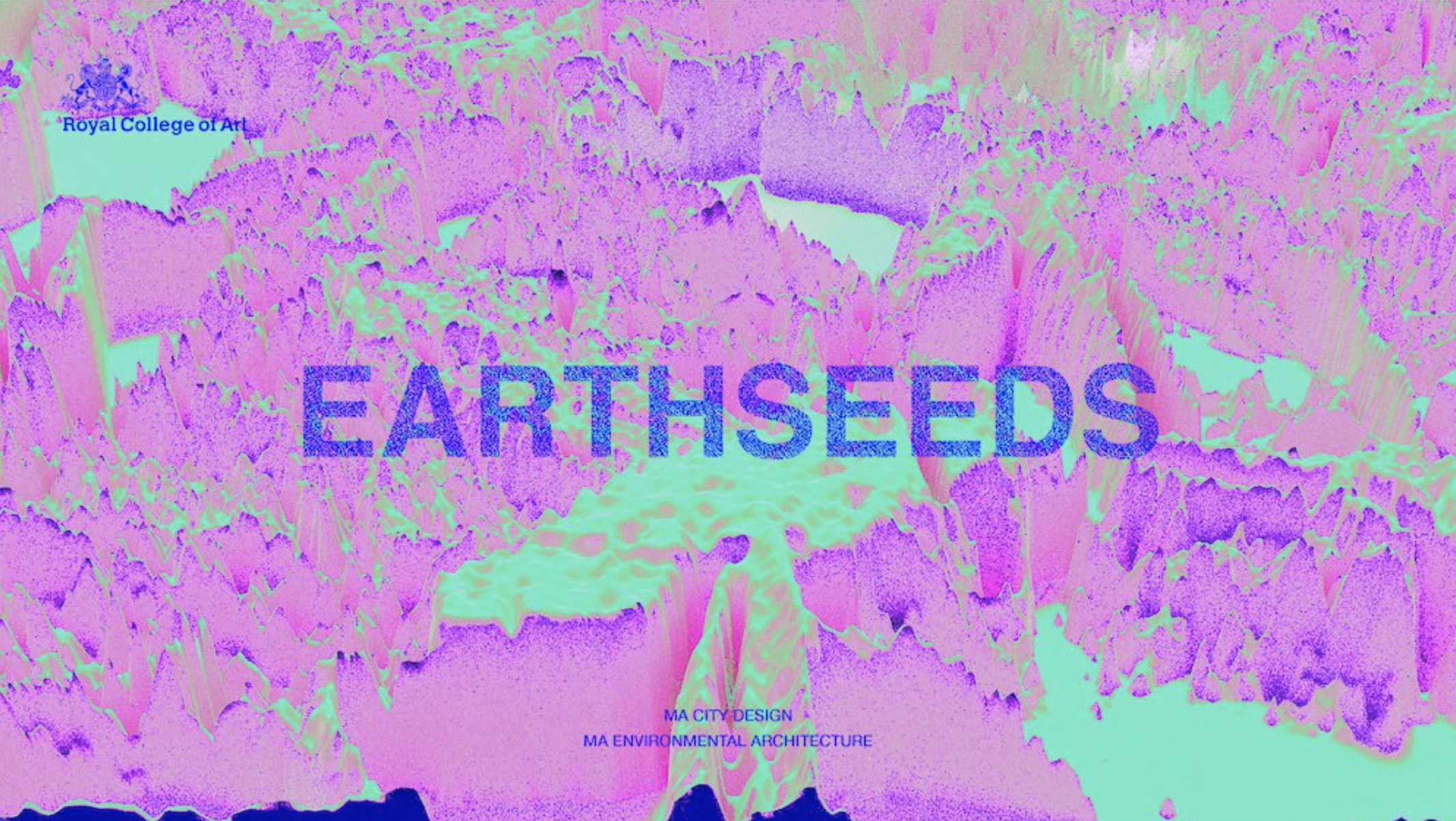
  • RCA Environmental Architecture: Earthseeds

    To celebrate the completion of the 2019-20 cohort we hosted a series of events as ‘Earthseeds’. I enjoyed chairing the discussion with Jessika Khazrik.

    Spanning three days, Earthseeds is led by the student community from both graduating cohorts, and features talks, conversations, performances and group discussions, focusing on issues of care, the environment, technology, climate and social justice.

    The title, Earthseed, is in reference to Octavia Butler’s book Parable of the Sower. To sow, to care, to adapt, to persist in the face of adversity and to change: a story that speaks to the uniqueness of this year and to our students’ capacity for adaptation and creativity  even in the most difficult circumstances.

    This is our first graduation show to take place online – the RCA2020 platform provides a profile of the work of each graduate, and their work is showcased using a range of dynamic formats.

    Delve into their work and explore the platform by searching graduate names or browsing by Programme or exploring topical themes told through stories.

    Earthseeds presents six separate events over three days:

    • Earthseed #01 – This event is a celebration of the work produced by the MA City Design and MA Environmental Architecture students at the School of Architecture, Royal College of Art.
    • Earthseed #02 – A Conversation with Kali Akuno of Cooperation Jackson
    • Earthseed #03 – ‘The Cleaner Your Whole House Will Be’ with Jessika Khazrik
    • Earthseed #04 – Curators Anna-Sophie Springer and Maria McLintock in conversation with students from the MA Environmental Architecture.
    • Earthseed #05 – Architects Stavros Stavrides and Tiago Mota Saraiva in conversation with students from the MA City Design
    • Earthseed #06 – Collecting Voids: An educational literary dialogue between Environmental Architecture and City Design

  • Bartlett/UCL MA Architecture Seminar 2020-21: Green New Deal/Green New Dialogues: Towards a World in which Many Worlds Fit

    Among my various teaching positions is a decade long post at the London’s Bartlett School of Architecture (UCL), where I have the pleasure to run an elective seminar each year for a selection of MA Architecture Students, broadly titled The Ecological Calculus. I attach this years reading programme below

    HT6 Green New Dialogues – Towards a world in which many worlds fit.

    Dr Jon Goodbun 2020-21

    The call for environmental justice, and the recognition that the effects of environmental change will be played out through class, gender, race and neo-colonial structures, articulates an essential socialisation and politicisation of what is at stake in thinking through our responses to ecological crisis.

    Given the emerging scale of the environmental transformations that we are still now only in the early stages of, demands for a new planetary project of ecological planning are being raised from many quarters. These demands call for rapid and fundamental changes to the global supply chains and processes of production that feed our transportation, energy, food, manufacturing and production systems. Questions of planning confront us at every scale, from the implementation of the recommendations of the UN IPCC, through the measurement geopolitical resource flows through new international solidarities, to emissions management and carbon sequestration, land use changes and so much more. As these demands hit the ground within specific historically and geographically determined conditions, they become inseparable from questions of environmental justice, questions of ownership, and questions of social management. The need for both critical reflection and multi-dimension design research in architecture, urbanism, landscape studies and design activism is clear.

    This double demand, for climate justice AND for an urgent ecological reorganisation and decarbonisation of the global production, have been articulated in different ways through practically all of the various Green New Deal proposals to have emerged in recent years.

    The first Green New Deal was proposed in 2008, in a joint paper written in the UK by a group from the UK Green Party and the New Economics Foundation, called the Green New Deal Group. This group has expanded and continued to produce new work to this day, including the introduction of a Green New Deal Bill (unsuccessfully) to the UK Parliament in 2019, by Green MP Caroline Lucas and Labour MP Clive Lewis, and which fed into the manifestos of both the UK’s Green and Labour Parties manifestos in the 2019 General Election. In the same year in the USA, the Green New Deal Resolution was put to the US House of Representatives by Representative Alexandria Ocasio-Cortez (AOC) and to the Senate by Senator Ed Markey, a platform that was also later adopted by the Bernie Sanders presidential campaign, and which is now strongly influencing (albeit with resistance to its more radical aspects) the emerging manifesto of likely Democratic candidate Joe Biden.

    Almost all of the Green New Deal papers have three main components in some form or other, perhaps most clearly laid out in the 2019 Green New Deal for Europe report put forward by Yannis Varoufakis and the DiEM group: 1. Green Public Works: a broad green transition, decarbonisation and job creation programme organised around an environmental justice agenda, 2. a new democratic, legal and institutional infrastructure for delivering this and achieving a just transition, and 3. an Environmental Justice Commission with a global remit.

    There were problems with the GND proposals as they stood in 2019. The adoption of a political imaginary from 30s depression-era US history might resonate in that region, and maybe UK/Europe, but it could easily be a problem in the rest of the world. Similarly, it was not clear how the demands for the growth of a new green infrastructure in the world’s richest nations would not actually reinforce an extractivist flow of mineral resources from the global south – such as lithium, cobalt, copper etc – and intensify some of the most environmentally problematic practices on the planet, almost invariably involving the exploitation and desecration of indigenous lands and peoples. In short, the GNDs, for all of their intentions otherwise, invariably articulated themselves through national concerns, and frequently risked unleashing a new green colonialism.

    The defeats sustained by the green left (Corbyn and Sanders) across Europe and North America and beyond through 2019 and into 2020 might well have been expected to have sunk the renewed interest in a Green New Deal agenda before it could really get going. But that has not been the case. There are several reasons for that.

    The SARS-CoV-2 virus, was identified in December 2019 in Wuhan, China. The first victims of the disease that it causes – COVID-19 –, have now been traced back a month earlier. By April 2020 the World Health Organisation had declared it a pandemic and it had spread around the world, placing large sections of the global economy in an uneven shutdown. In fact, the uneven pattern of infections, deaths, and changed spatial and labour relations, revealed that a pandemic is never simply the product of a mass of viruses, spreading through a neutral space and affecting everyone equally. It is rather, the result of what happens when our normally obscured environmental architectures of social relations act as a discriminating exposure infrastructure for pathogens and pathologies of all kinds.

    The evidence is clear that the death rates for working class ethnic minorities from COVID-19 are quite disproportionate. Being poor and black is, it turns out, in terms of medical statistics, a pre-existing condition. But the death and serious infection rates for ethnic minorities under COVID-19 are simply amplifying what we have already long known – that environmental change, breakdown and crisis, ALWAYS play out through the class, gender, race and neo-colonial structures.

    Arguably today the single most important development as the GND has moved beyond a green infrastructure and solutions-based discussion, towards the broader dialogue now maturing into a multi-scalar counter-hegemonic political project, has been the productive and critical engagement of indigenous communities across the Americas and beyond with the GND question. This is certainly in no small part due to the fact that Ocasio-Cortez was already recognised by these communities as a ‘Water Protector’, through her activist work at Standing Rock in opposition to the oil pipeline across Sioux lands, which preceded her standing for election to Congress.

    The Indigenous Environmental Network called for any GND to work within their Just Transition framework, cautioned against using the language of ‘stakeholders’ rather than ‘rights holders’, and strongly criticised the adoption of REDD+ (simplistic reforestation to offset emission) and the use of a language of zero-emissions, which they argue is always ultimately the language of a carbon trading ‘green’ capitalism.

    Meanwhile revolutionary indigenous activists The Red Nation –  published their response, the Red Deal, stating that:

    ‘it’s not the Red New Deal as it is the same ‘Old Deal’ – the fulfilment of treaty rights, land restoration, … ours is the oldest class struggle in the Americas: centuries long resistance for a world in which many worlds fit… The Red Deal is not a counter program to the GND. It is a call for action beyond the scope of the US colonial state.’

    The environmental racism revealed by the COVID-19 pandemic has helped to feed a massive new wave of struggle around #blacklivesmatter and #antifa, in parallel with an unfolding political and economic struggle over the repercussions – both positive and negative – of the lockdown of economic activity. For those now fighting for a just recovery, and those who want to use this moment to restructure and rebalance the global economy, have found in the GND a set of ready made positions to align with.

    However, there are fundamental problems regarding the very possibility of planning and justice. We need to somehow plan these changes, but we need also need to totally reimagine the very possibilities of planning, as a part of the problem is our ideas about planning themselves, or rather, the very fact of our attempting to plan anything, especially regarding ecological systems. When goals are set by an instrumental conscious purpose based upon a necessarily partial viewpoint, and unmediated by a wider eco-systemic awareness, all kinds of pathologies play out. The great lesson of radical cybernetics was not ‘how to control ecological systems’ but rather that we can’t control ecological systems. We can steer a boat, but we can’t steer an ocean…

    This seminar will review the key documents that have emerged regarding the Green New Deal in recent years, and the wider global discussion, in particular looking at responses from indigenous communities and the Global South. In particular, we will take up the Zapatista demand – rearticulated by The Red Nation – for a ‘world in which many worlds fit’ as the key framework for articulating a Green New Dialogue…

    Week 1: Designing in the End Times

    UN IPCC Summary Report:

    Summary for Policymakers of IPCC Special Report on Global Warming of 1.5°C approved by governments

    https://www.ipcc.ch/2018/10/08/summary-for-policymakers-of-ipcc-special-report-on-global-warming-of-1-5c-approved-by-governments/embed/#?secret=eJtf6gbbVS

    Jon Goodbun interview with Caliper Journal:

    https://caliperjournal.online/TOM-LEMON-DR-JON-GOODBUN

    Kathryn Yusoff, A Billion Black Anthropocenes or None. University of Minnesota Press. Minneapolis, 2018

    (Available free online at https://manifold.umn.edu/read/untitled-5f0c83c1-5748-4091-8d8e-72bebca5b94b/section/5cd42c2a-f2fe-4d41-89ae-cb891dc634b5)

    Secondary

    Zadie Smith, What Do We Want History to Do to Us? 

    What Do We Want History to Do to Us?

    https://www.nybooks.com/articles/2020/02/27/kara-walker-what-do-we-want-history-to-do-to-us/embed/#?secret=Afm2aMWtRZ

    Week 2: The Green New Deal: Problems and Possibilities

    Alexandria Ocasio-Cortez, Naomi Klein and The Intercept:

    A Message From the Future With Alexandria Ocasio-Cortez

    DiEM, A GND for Europe/A Blueprint for Europe’s Just Transition:

    https://www.gndforeurope.com/

    Why Race Matters When We Talk About the Environment, An interview with Dr. Robert Bullard

    Why Race Matters When We Talk About the Environment

    https://www.greenpeace.org/usa/why-race-matters-when-we-talk-about-the-environment/embed/#?secret=i4SVi3EsMf

    Secondary

    Labour for a GND:

    https://www.labourgnd.uk/our-vision

    Green Party: What is the GND

    https://20for2020.greenparty.org.uk/articles/gnd

    Jon Goodbun, ‘Green New Dialogue’, in Making Futures. Berlin, 2021 (prepub)

    Kate Aronoff, Alyssa Battistoni, Daniel Aldana Cohen and Thea Riofrancos, A Planet to Win – Why We Need a Green New Deal

    Noam Chomsky and Robert Pollin, Climate Crisis and the Global Green New Deal

    Ann Pettifor, The Case for the Green New Deal

    Week 3: Climate Justice and Indigenous New Deals

    Ghassan Hage, Is Racism an Environmental Threat? Cambridge: Polity Press, 2017

    The Red Nation, The Red Deal

    https://therednation.org/2019/09/22/the-red-deal/

    Indigenous Environmental Network, Principles of a Just Transition

    Just Transition

    Just Transition

    Secondary:

    Jon Goodbun, On the Possibility of an Ecological Dialogue

    Jon Goodbun: On the Possibility of an Ecological Dialogue

    https://www.making-futures.com/jon-goodbun-on-the-possibility-of-an-ecological-dialogue/embed/#?secret=RdscQlg8vg

    Week 4: A world in which many worlds fit

    Arturo Escobar, Designs for the Pluriverse. Durham NC: Duke University Press, 2018

    Matt Broomfield, How a Revolution Really Feels: Rojava 8 Years On

    How a Revolution Really Feels: Rojava 8 Years On

    https://novaramedia.com/2020/07/17/how-a-revolution-really-feels-rojava-8-years-on/embed/#?secret=cQqHG0Y78M

    Donna Harraway, Staying with the Trouble: Making Kin in the Chthulucene.  Durham NC: Duke University Press, 2016

    Week 5: The Production of Nature

    Martin Arboleda, Planetary Mine – Territories of Extraction under Late Capitalism. London: Versos, 2019

    Jason W Moore, Capitalism in the Web of Life. London: Versos, 2015

    Elizabeth A. Povinelli, Geontologies: A Requiem to Late Liberalism.  Durham NC: Duke University Press, 2016

    Secondary:

    Jon Goodbun et al, The Design of Scarcity. Moscow: Strelka, 2014

    Week 6: Responses from architecture and design schools: contributing to a Green New Dialogue

    Leopold Lambert, Futurisms Introduction for Funambulist Issue 24 

    https://thefunambulist.net/articles/futurisms-introduction-leopold-lambert

    Billy Fleming, Design and the Green New Deal

    Design and the Green New Deal

    https://placesjournal.org/article/design-and-the-green-new-deal/embed/#?secret=mpbyDEFkem

    AALU discussion: How do we confront a world on fire? – Design and The Green New Deal on a Warming Planet

    https://www.aaschool.ac.uk/publicprogramme/whatson/session-6-how-do-we-confront-a-world-on-fire–design-and-the-green-new-deal-on-a-warming-planet

    Secondary:

    The Green New Deal Superstudio: An Open Call

    https://www.wconline.com/articles/93214-the-green-new-deal-superstudio-an-open-call

    The Architecture Lobby, Statement on the Green New Deal

    http://architecture-lobby.org/project/t-a-l-statement-on-the-green-new-deal/