Author: jongoodbun

  • The Ecological Aesthetics of Food Production at Arcosanti

    I have spent the last few days with Karin working on a paper for André Viljoen and Katrin Bohm’s conference AESOP 2ND EUROPEAN SUSTAINABLE FOOD PLANNING, which will be hosted by University of Brighton later this month. I have posted our paper abstract below.
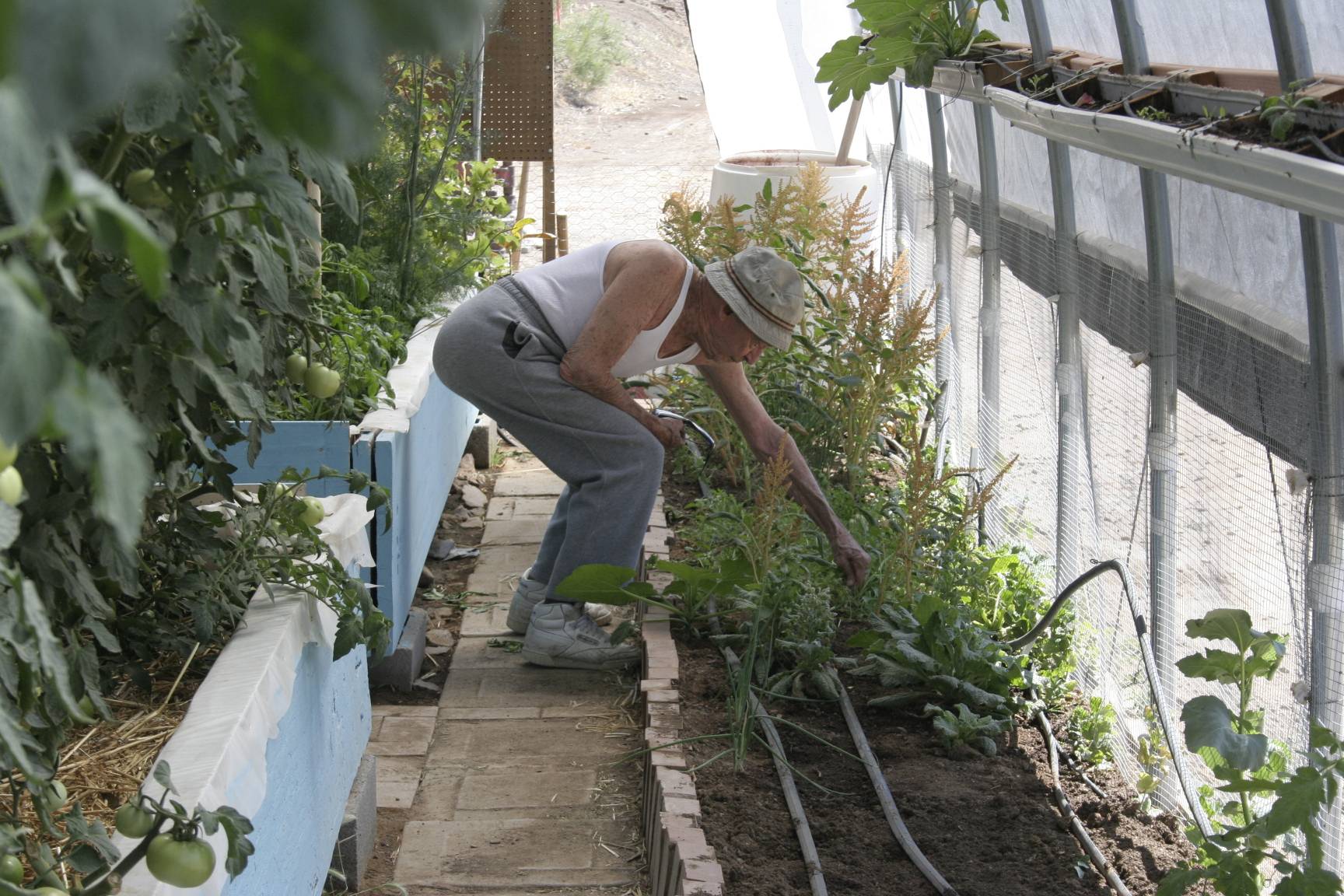
     

    Paulo Soleri in Arcosanti greenhouse picking food, May 2010 (by author)


    The Ecological Aesthetics of Food Production at Arcosanti

    Jon Goodbun and Karin Jaschke

    In this paper we will explore ‘paradigms and strategies for urban and rural planning and design’, and ‘definitions of sustainable metropolitan agricultural systems’, using as a case study the recently revived plans for food production at Arcosanti. We will use new and previously unpublished on-site interviews and documents to discuss these developments, as well as reflecting upon Paulo Soleri’s distinctive methods of ‘scenario building, visioning and public engagement’. In discussing these matters, we will draw upon a somewhat forgotten 1970 paper by Gregory Bateson – Restructuring the Ecology of a Great City – arguing that following Bateson, we must not think of food systems as solely energy and material flows – progressive though this would be. Rather, food ecologies are as much to do with communication and information flows, and can only be properly grasped through what Bateson described as an ecological aesthetics.

    The complex challenges faced by the historical and ongoing development of Arcosanti reflect contradictions within the urban food movement more broadly. Whilst much of the recent discourse around urban food production assumes that any such developments will necessarily be based in grassroots, socially progressive ‘grow your own’ and ‘transition town’ type initiatives, facilitated by designed organisational systems (planning) of one kind or another, this will not necessarily be the case. Indeed, one can presume that if there is any sense to urban food production at all, then the normal forces of capital accumulation will soon get to work. Indeed, many of the more recent proposals that are emerging within the architectural imaginary are precisely of this form, for example the vertical farms which by definition require significant capital investment, and are no doubt based upon private ownership of production.(1)

    In fact, whilst generally seen as a critical of the forces of capitalism, the progressive character of the transition town type model is itself by no means uncontested. There are important reasons to be suspicious of the ideology that can be found lurking not far beneath the surface of many ‘return to localism’ movements. For example, in a recent article Andy Fenwick has argued that the Transition Town type strategies entail, from one kind of Marxist perspective at least, multiple problems including: a confused appeal to a mythical past, exporting unemployment to developing countries, reliance upon local currencies acting as local trade barriers, and cheap labour.(2) More importantly, these movements can easily be accused of false consciousness – that is to say, giving the appearance of radical change, whilst actually diverting energy away from confronting the real and fundamental source of environmental and economic crisis: capitalism itself.

    Nonetheless, the ‘metabolic rift’ described by Marx has never been so alarming, and the need for a radical cultural re-conceptualisation of our food systems would seem to be undeniable. Transition culture can rightly claim that the very real instability of capitalism in the contemporary period, and the very real possibility of near future resource wars, and/or a collapse in global trade, demands a robustness to food production that only local knowledge and production networks can provide.

    We will explore how these broader socio-economic contradictions might be reflected in the experimental setting of Arcosanti, and suggest how a conception of ecological aesthetics might help make visible the multiple levels of consciousness – both radical and false – that all of these experiments necessarily project.

    (1) See for example http://www.verticalfarm.com/. In Detroit, as has been well documented, grassroots initiatives (see for example http://www.urbanfarming.org/) are being challenged by larger scale commercial propositions (http://www.hantzfarmsdetroit.com/). There is an emerging distinction, between urban farming proposals that stage and experiment with new social forms and new relations to nature, and those that are simply vehicles for private capital investment and profit.
    (2) See Andy Femwick, ‘Transitional Communities – a dead end for the environment’ in Socialist Appeal, accessed from http://www.marxist.com/transitional-communities-dead-end-environment.htm
  • Scarcity: Reality and Ideology

    The text below was a short discussion piece produced for the research project SCIBE (Scarcity and Creativity in the Built Environment). This research project is just a few months old, having been awarded funding by EU HERA. Jeremy Till is the Principle Investigator, and University of Westminster the lead institution. I contributed to the original research funding bid earlier this year (for €1M), and am engaged for around a day a week for the next three years, working on the project. The project web site is www.scibe.eu, although there is not much there yet!

    Scarcity: Reality and Ideology

    Scarcity is both a reality, and an ideology (a complex term, which I use here in the classic marxian sense of ‘false consciousness’).

    There is a system of production (capitalism.) Real ‘scarcities’ play real roles in that system.. ie there are real material and energy flows, which ultimately have a combination of natural and social foundations. At any one time there are limits to these flows – ie there are real scarcities.

    In addition, the concept of scarcity plays an ideological role. That is to say, it naturalises (it makes obscure) the socialcomponent of the limits of these flows: Those elements of the limits (at any given time) to material flows which are social in nature- ie determining who gets what proportion of the available materials and energy is according to a range of social constructs such as money, location, nationality – are obscured, and made to look inevitable, natural, the democracy of the market etc

    This is compounded when it is realised that those in the system who own and manage these flows have a vested interest in maintaining scarcities. Scarcities, the control of resources, are real social power. (In energy supply for example, big power companies are most obstructive to local generation, and most supportive of nuclear. And as I think Bookchin noted, a wind farm owned by a multi-natational power corporation is not an alternative technology!)

    Scarcity works dialectically with abundance, as the same system, at the same time as producing scarcity in the ways described above, also constructs ‘abundance’ as both a reality and an ideology. Most notably here, promoting the false consciousness that we can extract as much as we want from the planet… so, we literally get hit conceptually I both directions… and this keeps people confused!

    In both cases then, the key ideological role is to obscure the real workings of the system – and to make it seem natural, incomprehensible etc etc

    So, where does design and creativity fit in? Well, designed objects and built environments play important roles in maintaining both of these concepts (and researching that role is one of the aims of this project.) Designed objects and environments often obscure their conditions of production, and also obscure the flows that they are a part of. Design and creativity. (which we could define as specific forms of self consciousness?), are contained within particular divisions of labour.

    So, we say that we want to critique the existing limiting division of labour that keeps creativity perpetuating a logic of scarcity, and we promote new expanded forms of creativity and design, that seek to both resolve the reality of scarcity, and expose the ideology of it. In both cases, this is achieved through a making visible and ‘democratic’ the ecology of economic flows through an extension of design (!!)

    Instead of only saying that we accept scarcity, do we simultaneously say that we refuse it? Or perhaps we say that we accept it as we want to take control of it? Do we argue that scarcity is going to become an increasingly political term, and that we want to reveal the full meaning of the term?

    Is the design task an ideological critique (in the sense of Tafuri) of the hidden conceptualisations of scarcity in existing design practices. Would an ideological critique look at different approaches and ask, in what ways are these design practices increasing false consciousness around the system of production? In what ways could they be revealing the networks and flows, or facilitating democratic ‘local’ control (and indeed ultimately ‘global’ control) of aspects of these systems, etc? What would the introduction of second order cybernetic, systems theory and ecology concepts bring to such a critique and practice?

  • Hydrotecture and Urban Metabolism: The Timing of Space

    Last year (2009-10) I ran a post-graduate diploma studio at University of the Creative Arts, Canterbury. This project by Chris Jennings-Petz was submitted by the school to the RIBA Presidents Medals competition.
    Jennings-Petz Ashford Metabolism
    Jennings-Petz Ashford Metabolism
    Ashford, an old Kent industrial/market town on the Stour river complex, plans to double in size over the next two decades, with 30,000 new homes. However, although Ashford has recently plugged-in to international rail networks, the town has remained formless, indistinct, unconscious.
    Research started with a mapping of the Ashford landscape as a metabolic entity, defined through demographic, infrastructural, economic, geological and urban flows. Forming what Bateson called “an ecology of mind”,  this allowed intriguing insights into socio-geographical processes. Work soon focused upon socio-geological water flows, and included a novel report into the embodied water of building production. Through his regional analysis, major weaknesses were found in the city’s water planning. This issue defined the design strategy remit and project thesis.
    The hydrological, agricultural and geological surveys revealed a band of clay and aquifer running below the city. In an ingenious move, Chris chose this as the (sub)site, and  proposed to excavate a string of region/city-defining reservoirs passing through the urban centre, slowly filling to meet the expanding water requirement. The waterside edges create a series of new urban landscape conditions, transforming land values, and introduce a new metropolitan space, and metabolic relation, into the heart of Ashford.
    A reservoir infrastructure was elaborated through a strong leisure programme, incorporating an ultra deep diving well, surface sports, a new ecological corridor with urban food production potential, and hundreds of floatation tanks. At the core of the scheme, the landscape both mounds, and drops to deep vertical wells, countering Ashford’s dominant horizontality. This move transforms the topography of the city, and perhaps reconfigures the cognitive maps of the city, in the inhabitants’ imagination.
    Working across scales, strategic regional moves were paralleled with 1:1 material prototypes that crystallised a series of open-ended experiments involving salt solutions and clay castings of various kinds. Samples and apparatus accreted around Chris’ drawing board through the year, defining a metabolic aesthetic. His evolving installations animated the diploma studios, whilst the proposal staged a urban landscape infrastructure, as a new ecological domain of social experience.